Author Archives: lilia
Media Update: RESPONSE TO INTRANSIGENCE OF THE TASMANIAN FOREST INDUSTRY ASSOCIATION
The ‘olive branch’ groups say their genuine offer to smooth the way for the forest industry to return to forest peace talks remains on the table despite its rejection by the Forest Industries Association of Tasmania (FIAT).
Whilst disappointed by the forest industry position, the groups point out that the Tasmanian government holds the key to ensuring a moratorium on logging high conservation value forests, in return for which they offer to suspend market action in Japan.
“Our offer is genuine and remains on the table despite the forest industry’s very disappointing outright rejection, as ultimately the power to impose a logging moratorium to try and get things on track lies with the Tasmanian government,” said Peg Putt for Markets for Change.
“We sent a letter to the government formally outlining our offer and have had an acknowledgment of receipt of the letter.”
“Just as FIAT has been in communication with Ta Ann customer companies in recent days so have we, providing an update on the independent verification group’s expert reports and on our offer of a market moratorium for a forests moratorium. We do not accept that our international or domestic communications should be censored whilst other forest industry stakeholders remain free to say and do whatever they please.”
“Consumers these days are concerned to know about the environmental impacts of the products they buy and want assurance that it is really eco-friendly when advertised as such, not misleading advertising like that in Japan that wrongly describes Ta Ann Tasmania’s plywood flooring range as plantation grown,” said Jenny Weber of the Huon Valley Environment Centre.
“It is not reasonable to expect that devastation of verified high conservation value forest is not restrained but that campaigns in defence of the forests are scuttled. That is a one-sided recipe without any element of compromise.”
Still Wild Still Threatened, Huon Valley Environment Centre, Markets for Change and The Last Stand.

Media Release: NEW FOREST SURVEILLANCE FOOTAGE MAKES CASE FOR MORATORIUM
 The full cycle of logging incursions inside Tasmania’s verified, but unprotected, high conservation value forests has been captured in eye-opening new surveillance aerial footage filmed yesterday, which reinforces the case and urgency for an immediate moratorium on logging activity.
These four environment groups have offered an olive branch comprising a suspension of their market action in Japan for one month on the condition that a moratorium is imposed over the 572,000 hectares under discussion for potential future reservation, whilst forest talks take place.
“We are yet to receive a response on the offer we made to government and the industry, and in the meantime we have gained spectacular new footage showing forests inside the 572 000ha that are being logged, roaded and burnt right now,” said Jenny Weber of Huon Valley Environment Centre.
“The cycle of forest destruction in Tasmania stems from the roads pushed in to pristine forest, large scale industrial logging operations and high intensity burning. The outstanding values of the forests are completely destroyed and we are losing significant tracts of world-class forests every single day.”
“At a time when the focus should be on moving out and moving on, Forestry Tasmania is instead bulldozing new logging roads deep into wilderness of global significance and logging verified World Heritage forests. Make no mistake, this is strategic destruction and must be reined in,” Ms Weber said.
“The rapid devastation that is occurring in Butlers Gorge is seeing their unique ecosystems lost by ongoing logging operations. This area has been identified by the West report as one of the most significant tracts of Tasmania’s tall eucalpyt forests. The wilderness values of these forests are indicated as a key reason for the recommendation of adding them to the Tasmanian Wilderness World Heritage Area,” said Miranda Gibson of Still Wild Still Threatened from the Observer Tree.
“Apocalyptic vision of the Forestry Tasmania regeneration burn in the Plenty Valley taken during our surveillance flight shows the unacceptable practice that blanketed The Channel in smoke yesterday. We filmed the aftermath of such fires inside the high conservation value area,” said Ula Majewski of The Last Stand.
“Regarding our olive branch offer, we have delivered a formal letter to government and await their response,” said Peg Putt, representing Markets for Change.
“We reiterate that our offer of a moratorium on market action is conditional on not continuing to log the forests under discussion for protection. Forestry Tasmania’s blatant attack on forests of the highest value which we have revealed, and their refusal to consider moving out, is a serious problem,” Ms Putt concluded.
Miranda’s Daily Blog: Day 112
The Mercury reported on April 2nd that the high level of smoke in the air was a potential risk for asthma sufferers. The article specifically mentioned the forest industry burn off that took place near me (the footage of which I uploaded on April 1st). They are also running a poll about whether forestry burn-offs are necessary or not. The majority of people, so far, have voted no.
There have been some comments on my blog about the burn off not being done by Forestry Tasmania. So I thought it would be good to clarify this a bit more. The burn off that is the subject of that footage was conducted by a company called Norske Skog. This company owns quite a bit of land in the Tyenna Valley, on which they grow and harvest plantations. There are quite a lot of plantations in my view of the valley, in fact. For this reason, I wrote on the video that the burn was done by the “forest industry”. (I didn’t name Norske Skog, as it is not a company we campaign against, so I’m sorry if that lead to any confusion). Some people have dismissed the burn, saying it’s only a plantation-based burn. And I think this brings up some interesting issues.
There are problems with forest industry burn offs. So far in my blog I spoke a little bit about the reasons why burning the type of forests where I am currently living (wet forest) is problematic. I spoke about the fact that it is an anthropogenic transformation of these mixed forest ecosystems into eucalypt dominated regeneration. This is one reason that burning is problematic. Of course, such issues are irrelevant when considering the industry burn off that took place on Sunday; because the land had already been stripped of its ecosystem long before this took place, back when it was first converted to plantation. However, there are still some serious concerns about these burns that need to be addressed. The health impact is a very important issue and was the subject of the Mercury’s article yesterday. The smoke was so thick that, according to the Mercury, the Environmental Protection Authority declared a “red alert” in the Derwent region and surrounds, due to the sudden increase in dangerous smoke particles. The level of damaging particles in the air was at 68 in New Norfolk on that day. This seems quite high considering the article declared anything over 25 to be of concern. Asthma sufferers in particular are at risk and were urged to take caution. Norske Skog said they would investigate whether the burn-off they conducted had anything to do with the situation.
Recent studies undertaken by Prof Bowman (University of Tasmania) and Dr Fay Johnston (Menzies Research Institute Tasmania) assessed the health impacts of smoke from forest burns and wood smoke. The Mercury reported (on Feb 21st 2012) Prof. Bowman to say “”If the industry says there are no alternatives, I say they are not trying hard enough.” He went on to explain that wood smoke needed special consideration as there were specific concerns around the harm it causes to human health.
This issue brings me back to a point that I made to the media on Monday, stating that there are many issues that need to be addressed to find a sustainable solution for the forest conflict. Although formal reserves for high conservation value forests is a critical component, it is not the only issue that needs addressing. It is no good to simply reserve an area of forest, without changing the forestry practices in areas that will continue to be subject to logging. And this includes plantations. Although the environment movement has strongly advocated for a transition out of native forest logging into the plantation that already exist, this does not mean that current plantation practices are perfect and should go unquestioned (including the issue of burn-offs). Since the beginning of the negotiation talks it has been clear to those involved that there are many issues that will need to be resolved, these include the question of alternatives to high intensity burns and also issues around plantation management.
Apart from the health effects of the burns, there is also the issue of carbon. These high intensity burns release a large amount of carbon into the atmosphere. At a time when climate change is an ever increasing problem, this is surely an issue that needs further attention. Forestry Tasmania estimated that in their burn-offs 197.6 tonnes carbon was released per hectare (Slijepcevic 2001 <http://www.forestrytas.com.au/assets/0000/0208/281_290.pdf>). This is for Eucalyptus obliqua forest. Statistics may vary when it comes to different types of logging operations, so these figures may vary for plantation burns. I wasn’t able to find any specific statistics on these.
I can’t claim to be any kind of expert on the issue of burns. But I do know that seeing that burn-off so close to me and dealing with the after-math of smoke throughout the night, definitely made me think that there does need to be questions raised about this practice, whether it be on private or public land, plantation or native forests, there are still health risks and carbon issues. I think that more work needs to be done to find alternatives, as Professor Bowman suggested. If Tasmania is going to have a ‘clean, green’ image it has to go beyond the number of hectares reserved and also include best practice for all elements of the industry.
Miranda’s Daily Blog: Day 111
Did you see Q and A on ABC last night? I sent in a video question for Terry Edwards (of Forest Industries Association of Tasmania). It was great to see they included my question! (Although they did cut my video off part way through). Here is the segment of the show featuring my question and the response from the panel.
I have to wonder if Terry Edwards has been paying attention in all those meetings over the past two years. His reaction to my question gives the impression that he has never heard anyone mention the figure of 572,000 hectares until now. He claims that environmentalists have upped the stakes from 430,000 hectares to 572,000. The figure has always been 572,000. It was the industry that pushed it down to 430,000. The Intergovernmental Agreement listed only 430,000 hectares to be put into a conservation agreement, though it still lists the full 572,000 as open for potential new reserves and it is that full area that was assessed by the expert team, lead by Professor West. The expert team looked at that full area because 572,000 hectares was what was on the table as proposed reserves from environment groups. And when they assessed the values, they found that it all contained substantial conservation values, including world heritage value. That is why it is crucial that logging is stopped immediately in that area. How can they continue to destroy the very forests they are sitting in a room talking about protecting. As they speak, the very values that have been verified as worthy of protection are being degraded on a daily basis, while logging occurs.
I found it very intriguing that Terry brings up the Trades Practices Act, saying that people shouldn’t misrepresent their products. This is a very odd comment considering that environmental groups have been the ones who have had to go out and tell the truth about the lies and misrepresentations being made by Ta Ann (a company represented by his organisation). Ta Ann tell their customers the wood comes from plantation. The reality is that it has been officially verified that they are driving the destruction of high conservation value forests.
As Andrew Wilkie pointed out, there are a range of reasons why the forest industry is in crisis. Including the fact, which has been verified by Professor West, that the industry has been over-cutting the forests. And in addition that Forestry Tasmania have made contracts that are not even possible to be fulfilled. Contracts are going to have to be renegotiated anyway, if the wood is simply not there. So why not make the changes needed to conserve these forests that have now been verified as globally significant?
It will be interesting to see how the rest of the industry and government respond to our offer of a suspension of the markets campaign, if a moratorium on logging is put in place. I guess we will have to wait and see if they respond over the next few days. Forestry Tasmania have come out very quickly, in what seems to be a knee-jerk reaction. Interestingly they are claiming that they cannot suspend logging because that area accounts for 50% of their contracts. And that it can take up to 9 months for them to re-work their Forest Practices Plans to move logging to other areas. These two facts raise serious questions about FT’s committment to the negotiations. If they claim they can’t get out of the high conservation value forests now, then will they ever be willing to? What about in when the negotiations are finalised – Will they still claim they have to keep logging and logging and logging? Will they still want to continue to log at double the sustainable yield, as was found to be the case with their current practices? If they cannot even meet a moratorium (over due by a year now, so they have certainly had enough time to plan!) then how will they respond to the rest of the negotiated outcome? The question that needs to be asked then, is how serious is the industry about finding a solution?
Media Release – 2nd April 2012: Olive branch offered on Ta Ann markets campaign
Environment groups have offered to suspend their markets campaign in Japan for one month while forest peace talks proceed, on the condition that logging ceases in the 572,000 ha of verified high conservation value forests whilst negotiations about protecting them take place.
“It’s a moratorium for a moratorium,” said Peg Putt of Markets for Change.
“Logging the forests that are the subject of discussions about their protection cannot be justified. Wood should be sourced from the remaining million hectares of native forest outside of the area subject to reserve claims, whilst an agreement is hammered out around reserve creation and forest industry restructure.
“We began our campaign with Japanese customers of Ta Ann because the promised moratorium on logging was not implemented and Ta Ann’s wood supply was officially identified as the key driver of logging within this area.”
“If logging ceases inside the verified 572 000ha, we will give the talks an opportunity to reach an agreement to protect Tasmania’s globally significant forests,” said Jenny Weber of the Huon Valley Environment Centre.
“The West report provides overwhelming evidence for protection of these forests. The damage that has been done from years of over-cutting the forests means that the conservation of the threatened intact forests is at the edge of a cliff. It is a critical time for these forests to be protected for world heritage, national heritage, carbon storage and species protection values,” Ms Weber continued.
Miranda Gibson of Still Wild Still Threatened, who has now spent 110 days perched in her tree sit 60 metres up the ObserverTree, has also been coordinating messages to Japan. Her tree top eyrie is located in one of the logging coupes under imminent threat inside the verified high conservation value forests.
“I will support the conditional moratorium on the markets campaign in Japan. Meanwhile, however, I will remain in the Observer Tree to bear witness and await a final outcome. I am keeping the Tasmanian devils and wedge-tailed eagles company whilst they wait for their homes to be secured. It is vital that during this period we continue with informative and educational campaigns,” Miranda Gibson said.
“We will advocate other vitally important things that must come out of an agreement, in particular that the improvements to the Forest Practices Code are fully applied, to ensure that areas outside the 572,000 hectares subject to continued logging when negotiations are resolved will be treated in an environmentally responsible manner, and not suffer the brunt of dramatically intensified logging.”
The groups all reject calls made by the forest industry (through FIAT) to constrain the right to freedom of speech, the right to association and the right to non-violent protest.
“We absolutely reject the call for draconian anti-protest laws, which would undermine the basic principles of our democracy. We intend to continue domestic campaigns to build awareness and public pressure on delivering protection for these magnificent threatened forests,” said Ula Majewski of The Last Stand.
“A long lasting outcome cannot be achieved by imposing curbs on democratic freedoms,” concluded Ms Majewski.
Miranda’s Daily Blog: Day 107
I’m back online! Yay! I’m so sorry to all my loyal blog-followers for the great big gap in my on-line life! Things all went a little bit haywire a week ago when I had what could be called a “snow storm.” My poor computer suffered terribly from moisture damage and refused to turn on. It was such a shame because I had written you all a lovely blog about the snow and was even making you a little video to show how spectacular the forest was looking in the snow. And then… it was all over for my poor computer who really would have preferred to spend its life in a nice warm, dry office somewhere in town, I’m sure. It’s been taken back to town for repairs and hopefully, fingers crossed, it will recover. Now I have a new computer. And a special water-proof, shock-proof, pelican case to keep out all that nasty moisture that seems to be floating around constantly in the air up here these days! I am hoping that the computer people will at least be able to save my documents and one of these days I will get to upload for you my blog and video about the snow. It was in fact the best day that I have had up here so far! What a day! And for my 100th day, no less! Out of the blue, a cold snap and so much snow. All kinds of snow… soft floating flakes that drifted down gently through the air, silently settling on the tips of branches. And then at other times, it was like a blizzard up here, the tree shaking about as the snow was thrown about in a turmoil by the wind, hammering pellets of snow hard against my exposed face and hands. And then at other times, the snow turned hard, morphing into hail. Or as it could be called “snail” (a snow/ hail hybrid) which jumped about like tiny bouncing balls and ricocheted off my platform. (I think some of these little fellows were partly responsible for the final destruction of the computer, after making small holes in the top of my tarp!).
Snow is one of my favourite things! It isn’t like common old rain. It is something special. Whenever it’s snowing I just can’t stop looking, watching, witnessing the miracle. It has the feeling of something magical. And the forest seemed like a magical place that day as the snow fell over the valley. Just one day. To celebrate my 100 day achievement. And then, the next day it was back to normal, like nothing had ever happened. Except, it didnt’ feel normal any more. The forest had a special glow about it the next morning. For some reason the sunlight seemed extra golden, and the leaves seemed extra green. The colours seemed somehow sharper, more radiant. The brilliant blue sky contrasting against the white tops of the snow-capped mountains that shimmered in the sunlight. The birds were out in full force, celebrating the sun with their cacophony of songs. Yep, the post-snow day was full of magic too.
Every time I start to feel like I had come to love and appreciate this forest as much as I possibly could… something happens. And I find that there is an even greater depth of appreciation that I had never even imagined. Things keep happening that lead me to see the forest in a new light, a new way, to love it even more and more and more. Snow day was one of those moments. Ever since that day I have seen the forest differently. Like I know a beautiful secret, that it has shared with me. I have seen its magic. And I will never forget it.
Now the weather has settled into a perfect equilibrium, not too hot nor too cold. Three days of pure sunshine! With nights of star-filled skies. It may not last long, I know that. The cold of the upcoming winter will start to move in again, any day now, I’m sure. But for now, I’m enjoying the pleasantness of this unexpected sunny weather. Though, of course, I am secretly looking forward to more snow!
Oh, there is so much to catch up on! I feel like it has been so long since I’ve been able to tell you anything! The biggest thing that has happened in regards to the forests has been the release of the reports by Jonathan West and his team of experts, which document the conservation values of the forests. There are about 2000 pages worth of reports, with lot of juicy information that I’m sure you can’t wait to hear about. So check out my blog over this coming week, because now that I’m back online I can’t wait to be updating you on all the interesting facts that I’ve been reading about!
My other very exciting news is that this morning I got to Skype into a group of school students in Victoria, aged 8-9 years of old. I talked to them about these forests, the Tasmanian devils that live here, what life is like up the tree, and gave a little tour of my tree-top home. It was a lovely moment of inspiration when I finished my little talk and saw all those hands shoot up into the air, keen as beans to ask lots of questions. They wanted to know how I get all my things up here, how I have a bath and go to the loo, what animals I’ve seen, how long I am going to stay up here, can I just ask the government to stop cutting down the trees? And what my plan is if the government doesn’t listen.
On one last note, unfortunately the unexpected extra expense of a new computer and the new super extra water-proof case has drained our limited funds quiet a bit. If anyone out there could spare a donation to help out it would be so much appreciated. You can pop money straight into our bank account any time you like! The details are below. Thank you so much!
Thanks for your patience and sticking it out through this long gap in my “daily” blog!
Miranda
Bank details for Observer Tree:
Bendigo Bank
Acc Name: Still Wild Still Threatened
Acc Number: 144673571
BSB: 633000
Media Release: Tree sitter reaches 100 days.
Miranda Gibson has been at the top of a tree in Tasmania’s threatened forest for 100 days. Ms Gibson’s extraordinary effort began in mid-december when she climbed to the top of the tree vowing to remain on her tree-top platform until the area was protected, as it should have been according to the Intergovernmental Agreement. Miranda celebrated her 100th day amid snow.
“For 100 days I have sat at the top of this tree, bringing international attention to the ongoing destruction that is occurring every day in Tasmania’s irreplaceable high conservation value forests. It is timely that today Jonathan West’s report has been released, giving clear evidence of the global significance of these forests.” said Ms Gibson.
“Documented evidence has shown that Tasmanian devils are living in this area of forest. The West report has indicated the significance of these endangered species and the importance of these habitat areas” said Ms Gibson.
“I am committed to staying another 100 days if that’s what it takes. However, I hope that Tasmania will not have to wait that long to see these precious forests protected” said Ms Gibson.
“To mark my 100th day in the tree sit we will be posting 100 letters to the corporate customers of Ta Ann. These letters, from community members, will send a strong message that Tasmanians do not want to see our world class forests destroyed to make veneer” said Ms Gibson.
“My 100th day has been a special day so far, with a spectacular show from the forest as it snowed for the first time since I have been up here. Despite the cold weather, I enjoyed the beauty of the forest in the snow. I hope that through my action people all around the world can share the wonder of these forests and help conserve them for future generations” said Ms Gibson.
Miranda’s Daily Blog: Day 95
I want to tell you a story about a poor farmer in Sarawak called Frusis Lebi, who has deformed hands and feet and is entitled to RM300 rent per month from the Sarawak government. Frusis put up a flag of political opposition at his house. How did the Sarawak government respond to this? The assistant agriculture Minister Mong Dagang saw to it personally, by instructing the ministry in writing to have Frusis’ government assistance cut off. The Minister defended his actions, reported in The Sun as saying “As a man of principle I’m not going to back out. We cannot continue to give the welfare assistance and subsidies because he is a strong opposition supporter. The welfare aid should be given to more deserving handicapped persons.”
This isn’t my usual blog topic, given it doesn’t have a great deal to do with forests. Though, in Sarawak, everything seems to have some connection to the forest industry…. it’s no big surprise that the minister in question has, according to the Sarawak Report, been caught seeking illegal kickbacks (worth $23 million US) over the sale of oil palm plantations. And has other ties to the logging industry in Sarawak. However, this is not the reason I am sharing this story on my blog. I felt deeply moved by this story when I read it, because it is one personal example of the way in which the corrupt politics in Sarawak impacts on peoples lives.
Reading about Frusis Lebi made me think seriously about the level of corruption that is at play in the homelands of Ta Ann Holdings. And we can’t pretend that Ta Ann Tasmania operates in a vacuum, they are influenced by and benefit from the corruption that occurs in Malaysia. The story above is an example that shows the way in which Sarawak is run like a virtual dictatorship. Chief Minister Taib has held office since 1981. He uses his position and power to create enormous wealth for himself, his family and his associates. Ta Ann Holdings is closely associated with Taib through personal and business relationships. Taib controls the distribution of Sarawak’s logging concessions. Unsurprisingly a vast amount of the concessions end up in his own hands or the hands of his political allies. The money generated from logging is distributed within Taib’s family and his circle of political associates. He is currently under investigation by the Malaysian Anti-Corruption Commission in relation to Sarawak’s timber industry. In fact, deforestation has been identified as a major driver of corruption in the state.
So where does Ta Ann fit into all of this? Well, for starters the company’s Executive Chairman is Taib’s cousin, Sepawi. Who also happens to be the Treasurer General of the leading political party, who have contributed to the ethnocide of Indigenous people. Sepawi was also at one time the director of the Sarawak Timber Industry Development Corporation (STIDC), who virtually control the timber industry in the state, including granting timber concessions. Unsurprisingly the STIDC has lucrative business dealings with Ta Ann. Taib uses the connections with timber companies like Ta Ann to increase his own wealth and that of his family.
Sepawi is not only implicated in destruction through Ta Ann’s direct dealings, he is also closely connected to the operations of other companies including Samling and Rimbunan Hijau. Samling have been accused of illegal logging. And their workers have been accused of violence and rape of Indigneous women who live in the area. The company’s response to such allegations was to threatened to cut off the villages transport until the accusations were withdrawn. Sepawi owns 70% of a company called Cayaha Uaya, which is part of the Rimbunan Hijau company, who have been condemned by NGO’s around the world for their practises of illegal and corrupt acquisition of logging license, violations of labour laws and use of violence and intimidation against local landowners and protestors.
This is just some of the levels of interconnection between Taib and the timber industry including Ta Ann, and the corruption that is involved. When Ta Ann set up business in Tasmania where did the money come from? Was it generated through corruption and theft of Indigenous land? And why when the company seems to have so much wealth in Sarawak are they propped up in Tasmania by tax payer funded subsidies and only asked to pay rock bottom prices for timber from our native forests? The Australian Government should be investigating the financial assets of Ta Ann.
If you haven’t already signed the cyber action about Ta Ann, please take a few minutet to do so. The campaign about Ta Ann has moved to a new website. It is now located at www.taann.net Please let others know about the change, so that everyone can keep up to date.
Reading about the interconnections between people in government positions and those running the logging companies in Sarawak reminds me of an announcement that was made here in Tasmania the other day, actually. Anyone heard of Evan Rolley? He has now been appointed executive director of Ta Ann Tasmania. Interestingly he used to be the director of Forestry Tasmania. And in fact wasn’t he the one who coordinated the contract between Forestry Tasmania and Ta Ann in the first place? He is also the director of Forest and Wood Products Australia and was at one time also the Secretary of the Department of Premier and Cabinet. The Greens have criticized the move claiming there is likely a conflict of interest. There does seem to be a strange fuzziness around the borders between the government and the forest industry sometimes in Tasmania, doesn’t there?
Miranda

Miranda’s Daily Blog: Day 94
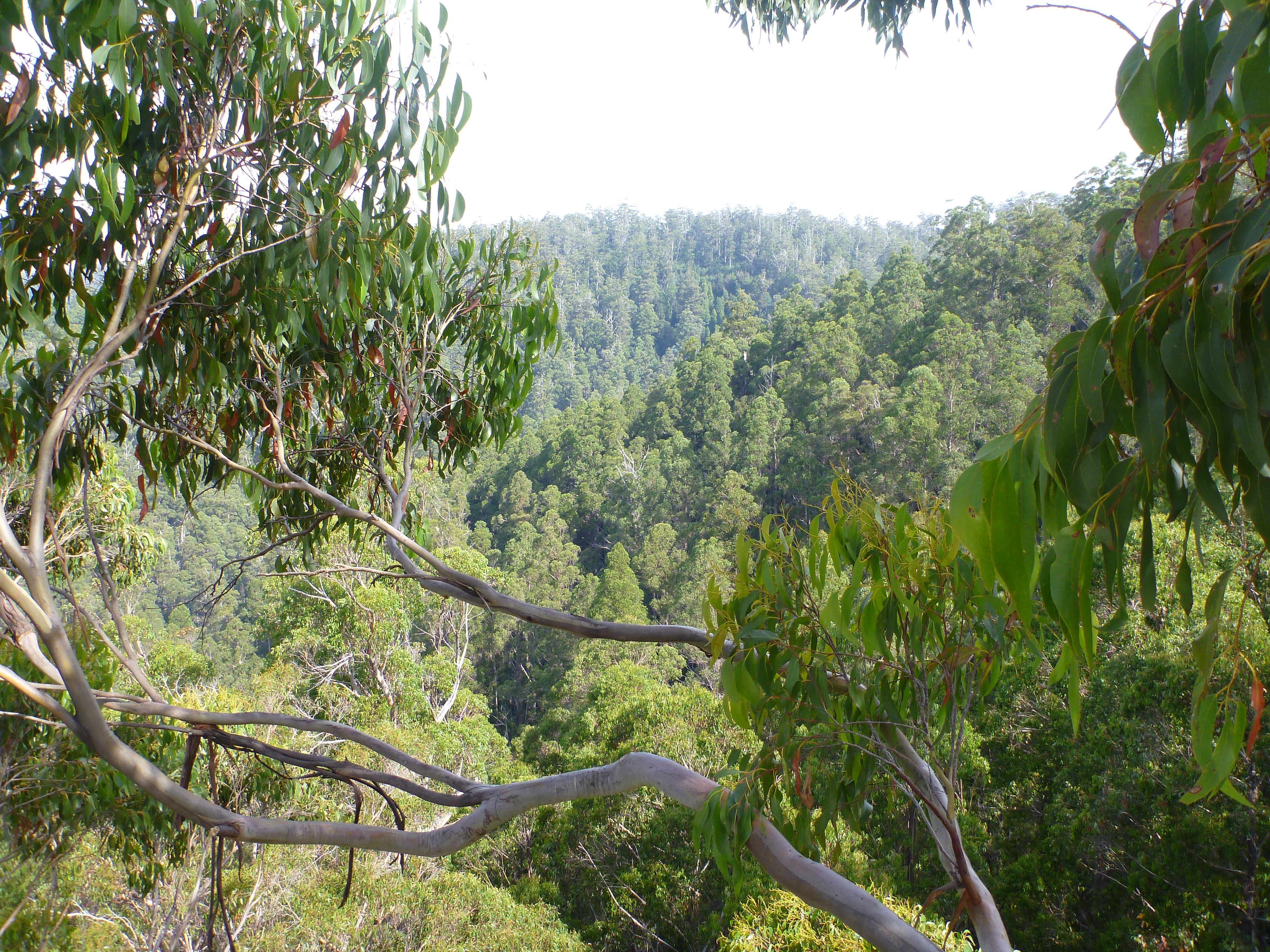 I looked out over the forest that I have looked out over everyday for three months. But I saw it with new eyes. The rain drops ran down my face, dripped into my eyes, blurring my view. I let them fall without wiping them away. I watched silently. I don’t know how long I stood there for. Taking in each subtle movement of the forest. The trees shifting in the breeze, the rain becoming softer and heavier. A shimmer of sunlight penetrating the clouds for a moment, turning leaves from green to gold and then back to green again as the clouds reclaim the sky. I watch the raindrops gather in little lines on the underside of my tree’s branches. The leaves become heavy and start to droop with the weight of water droplets that slide gracefully down the leaf’s spine, hesitating for a moment at the very tip, before letting go. I reach my hand out to the branch. I have come to know this branch so well, I sit on it, lean against it, even do some of my exercises supporting my weight with it, and I always look out at the forest through the window it makes around my view. But now I really get to know it. In a way I have not seen it before. I touch each crease. The wrinkles that gather underneath. They are like the soft wrinkles of that once gathered in the fold’s of my Nana’s skin, but as though they have suddenly been turned to stone. The wood hard beneath my hand. On these branches the bark is smooth and when you look at it, there are more colours on the branch than it is even possible to describe. Shifting shades of greens and brown.
I know they like to call environmentalists “tree huggers” as an insult. And without wanting to play into their stereotypes, I have to say, that I love this tree. I love every crease in the bark. The little hollows where spiders retreat to each night. The hanging strips of bark that seem to have peeled away a little more each time i look at them. The flowers that have come and gone. Floating away on the breeze to join with the millions of other golden migrating flowers, softly twisting and turning in the air.
Lately I haven’t felt like writing. I haven’t really felt like talking. Strange, I know, since my last correspondence with you was all about feeling lonely. But in this strangely meditative quietness I just feel like watching. quietly. I’m not thinking about the campaign, or about what I might have for dinner, or who I’d like to call me up on the phone. I am not really thinking about anything at all. Just taking it all in. Really watching, really seeing.
I touch my hands against the tree. And I feel for the first time I am really acknowledging it’s presence. I realise how strange it is that I wait for birds to visit in order to break my loneliness. When actually I have never really been alone. This whole time I have been in the presence of this magnificent tree. It has quietly kept me company.
This tree has been growing for hundreds of years in this forest. It has known many creatures, birds and insects in its life. They have come and gone. As will I. It has been home to many. Now it is home to me. Thinking of the stories people have told me about plants, I wonder if there tree notices me and how it responds to my presence here. I think about the information people have relayed to me, of experiments done with plants, proving that they do in fact react to people. You probably know the ones, experiments showing that plants change if people want to cause them harm or if people care for them. I hope my tree knows that I am here to do my best. I hope my tree knows.
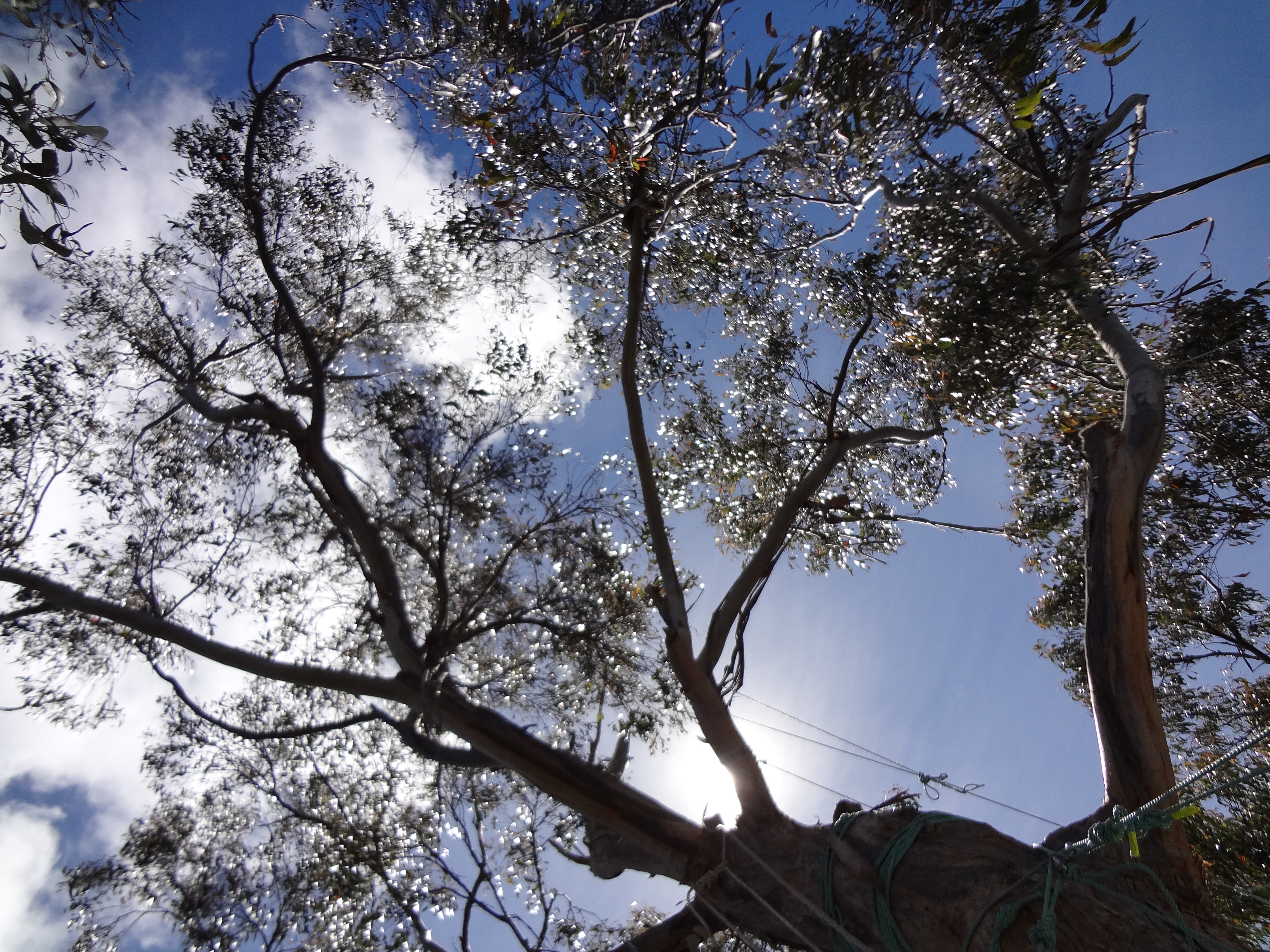
“Dear Tree,
I want to tell you why I am here. In case you have been wondering what this is all about. These ropes, this platform, and this strange human! It is very unusual to have a human move into your branches, I know. The thing is that there are some people out there who want to come and cut you down. They want to cut down and burn this whole forest around you. I want to help protect you. But I don’t know if I can.
I want to help the world see how magnificent you are. I want to share the beauty of this forest with people so that they will help to stop the destruction. But I don’t know if we can stop it in time.
I have loved other trees before. I just want to be up front and honest about that. I knew well a tree that I called “front sit” not too far from here. I promised Front Sit that I would defend it. Prehaps I was naive and I didn’t realise the power wielded by those who are in the business of destruction. I thought if I cared enough I could save Front Sit. I don’t want to worry you. But I want to tell you the truth. Front sit is gone now. I watched as the chainsaws tore through its flesh, their motor’s howling. Pools of woodchips spreading across the ground. I watched as Front Sit heaved and cracked. I watched as Front Sit hit the ground. And from then on I quietly watch the stump left behind, and I am filled with regrets. I am sorry I promised protection that I could not offer. I don’t want to have any illusions with you, Tree. When they come, they may come with a force so powerful that I can do nothing against their chainsaws, their machines, their money, their greed. I will not make you any promises I cannot keep.
Yet, my Tree, I want you to know that I will do all that I can. That I am doing all that I can. Right now. And although I am afraid that I cannot do enough in enough time, I have not given up hope.
Tree, I want you to know that I love you. And although you do not know them, there are many others who love you too. Many who have seen your branches, from right across the globe. I wish you could know, as I do, how many there are who love you. And who are doing everything they can to stop the madness of destruction.
Thank you, Tree. Thank you for having me. For keeping me safe in your arms. I hope that we will know each other for a long time to come. I hope that one day when I don’t live up in your canopy any longer I will be able to come to visit you. I hope that you will be free to keep growing tall and strong. I hope you will know many more animals and birds and insects and give them shelter for years to come. And I hope when you are old and your time comes, that you can fall to the earth in peace. That your body can lay on the forest floor and be taken back in by this forest to give new life.
All my love, Miranda”
I lie flat on my stomach, peering over the edge of the platform. I look down the trunk of my tree. I take in the shape and size of every branch, trying to sketch it into my memory. I never want to forget my tree. I look far down to the ground, where its trunk rises up from the dirt. Its roots stretching deep down below. I run my eyes over every detail and take it all in as I have never done before.
I have not written you a blog in a week, I know. And I am sorry. The last time I wrote I spoke about isolation and loneliness. I have found it difficult to know what to write to you lately. Now I have so much I want to share, but some of it is hard to describe in words. It has been a new journey for me. From this feeling of isolation to a new connection to this tree and this forest. And I feel an uncanny strengthening of my resolve. It’s getting close to 100 days up here now. I feel like I could stay another hundred. Whatever it takes to see an end to the wasteful destruction.
I want to say thank you to everyone who has been writing comments on my blog. My last post has 28 comments so far! I really love reading your comments. And especially after the last blog, I felt a lot less alone from all the encouragement and support that you showed. So, thank you. I’m very sorry for not writing much this past week. Some days I am so inspired to write, I just sit down and write and write. Other days I struggle to know what to say. So, I hope you will forgive me for the short breaks in blogging.
Thank you,
Miranda


 T h e O b s e r v e r T r e e