Category Archives: Videos
Miranda’s Daily Blog: 249
It was great to have guests visiting the Observer Tree this week, all the way from Japan. And it was so great to finally meet Akira Harada, from Japan Tropical Forest Action Network (JATAN). We have had many emails back and forth over the past eight months and some talks over Skype, collaborating on the campaign for forest protection. For grassroots groups in Tasmania and Japan to work together has been so valuable in exposing the truth to the Japanese customers of Ta Ann.
A large amount of Tasmania’s high conservation value forests are ending up in Japan. Malaysian company Ta Ann are selling these products to their corporate customers in Japan, labelling them as “eco,” environmentally friendly. Please take a moment to send a message to those customer companies about the destruction of Tasmania’s forests: click HERE.
Although we were only able to talk over the walkie talkie, separated by 60 meters, it was great to meet Akira and his associates. While they were here they made me a warm soup for lunch and sent up some lovely presents. I hope that we will continue to work together, from Tasmania to Japan, to help protect these precious forests.
I hope you enjoy this video blog:
From Thursday’s media release:
Mr Akira Harada, a spokesperson for Japanese ENGO JATAN who is currently in Tasmania inspecting the logging of high conservation value forests that were exempted from a logging moratorium, said “I am not happy to witness the logging destruction of Tasmania’s magnificent forests that are of global importance. It is not acceptable for the market in Japan to buy the product of such forest destruction sold as ‘eco’ wood.”
“It is vital that such forests are protected, and that Japanese customers of Tasmanian product such as that sold by Ta Ann can then have confidence that their product is from acceptable sources. This is not yet the case,” Mr Harada said.
Miranda’s Daily Blog: Day 234
Check out this video blog about a visit I had this week from the United Nations Youth Representative for Australia.
Miranda’s Daily Blog: Day 230
“I’m sorry” a voice crackled through the walkie-talkie radio. ” I tried to dry your slippers by the fire, but part of them melted.” This carefully chosen birthday present from my Mum had only arrived two weeks ago. When I pulled them up on the rope and looked at those crinkled up slippers, I felt like crying. “This is ridiculous!“ I thought to myself… “am I really crying about a pair of slippers?” But I knew in reality it wasn’t about that, it was the accumulation of eight months worth of loneliness, frustration, isolation. Of missing my family and friends. Of the monotony of every day confined to a small platform. And most of all, of looking out across this valley not knowing if tomorrow I will hear the sound of chainsaws and lose this forest forever. As I sat there in the rain, my usual optimism began to wane, as I thought to myself, “Can I really keep doing this?”
How do I go from this moment of feeling like I just can’t cope… to finding the strength it will take to continue this vital action on behalf of these forests? Well, my courage came in the form of a youtube clip. I know that might sound as bizarre as crying over a pair of burnt slippers! But, it’s true. Because watching an interview online with an Indigenous man from Sarawak put everything into perspective for me.
The Sarawak man being interviewed by Canadian news program “16×9” remained anonymous, for fear of the repercussions of speaking out. He had been involved in peaceful community protest against the logging of the forests that his people depend on for their very survivali. And so, if I am ever missing home comforts… I will remember what people in Sarawak will go without if logging continues to decimate their lands.
And if I ever feel lonely here… I will remember what many people around the world may face for taking a stand. Here I may be alone, but I have my phone and computer to connect to the world, support crew on the ground and a beautiful forest. Compare this to solitary confinement in a Malaysian prison. This is what the anonymous interviewee had suffered as a result of trying to stop logging.
Logging has been going on for a long time in Sarawak by a range of different logging companies. And so has the community resistance to it.
In recent times our attention in Tasmania has turned to the role that Ta Ann have in the industry, since the Sarawak-based company branched out to establish Ta Ann Tasmania, setting up two veneer mills here.
A recent statement was released by the Indigenous Penan people, fingerprinted by the chiefs of six villages in north Sarawak that are impacted by Ta Ann’s activities. The statement named Ta Ann and raised concerns about destruction of their lands, done without prior consent or knowledge and in contravention to the legal rights of the Indigenous people.
“this area should not be re-logged as it was being logged in the past which have made our livelihood difficult especially our food resources” the statement said.
“As a result of the previous logging activities our river are now muddy where as our traditional food are depleting and it is difficult to revived/rehabilitate.”
“Because of that, our present here are to inform all the stakeholders that we with one voice that we don’t accept any type of logging to take place within our Native Customary Rights Land.”
Sometimes people criticise my action by saying “Why don’t you go to Borneo instead?” But the fact is that destruction in Tasmania’s forests and the loss of Sarawak’s forests are both devastating and intricately linked.
It is clear that Ta Ann came to Tasmania in order to give environmental credibility t0 their company on an international level. After interviewing CEO Wong, it was reported in the Malaysian media “Due to Japan’s adoption of an eco-friendly lifestyle this will benefit resource-based group Ta Ann Holdings Bhd. Ta Ann stands to benefit as it has a 20-year log purchase agreement with Forestry Tasmania.”ii The misrepresentation of Tasmanian timber as “eco” friendly has implications both in Tasmania and Sarawak.
Right now Ta Ann’s “eco-ply” contains wood from forests that have been verified as world heritage and national heritage value by government-endorsed independent teams of scientific experts, and recommended for protection. In fact, it has been officially documented that this company is one of the key drivers of destruction in those forests. The timber produced from Ta Ann Tasmania does not comply with the guidelines for sustainable forestry that overseas customers expect” iii. You just have to scroll down the page on my website to see some of the amazing forests that have been or are due to be logged for Ta Ann.iv
There is no doubt that what happens here in Tasmania will have repercussions in Sarawak. Ta Ann can use their so-called Tasmanian “eco” wood to present themselves on the international market as good corporate citizens. Thereby glossing over the destruction of forests and disregard for indigenous rights elsewhere. Tasmania and the globally community must stand in solidarity with the people of Sarawak, by exposing the truth about Ta Ann’s activities in both places.
Please help by clicking HERE to send a message to the corporate customers of Ta Ann.
Take a look at this short film about Ta Ann:
Ta Ann Film from Dylan Grimwood on Vimeo.

Miranda’s Daily Blog: Day 223
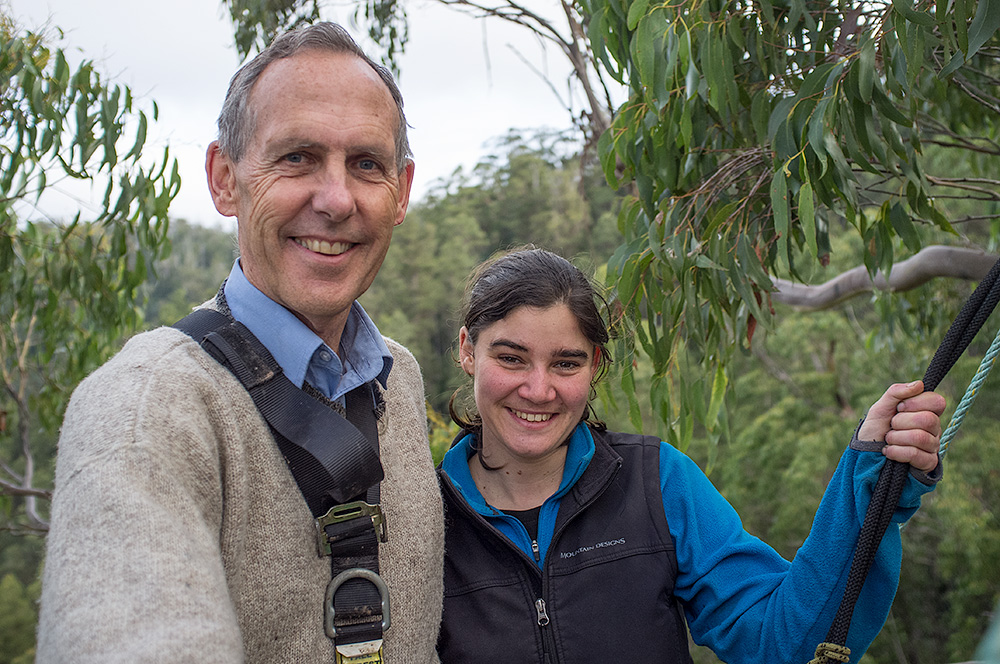
What an inspirational day I had yesterday with Bob Brown!
Please help to protect Tasmania’s precious forests:
CLICK HERE to take action now.
A forest a day! July 24: PC085A, Picton Valley

Image by Nishant Datt
Some areas of tall eucalypt and old growth forests in the Picton Valley have been intensively logged for many years. However, significant large tracts of these world heritage value forests remain, and their urgent protection from ongoing logging practices will ensure their globally unique values be spared from the chainsaw.
The tall eucalypt forests in the Weld, Picton and Middle Huon Valleys are collectively part of the largest single tract of tall eucalypt forest ecosystem extant in Tasmania.[i]
In the Picton Valley now, there is one area of verified high conservation value forest that is being logged, and three large areas of verified high conservation value forests that remain under imminent threat. All of these forests were left out of the promised conservation agreement that could have provided interim protection for these ecosystems.
One such area is logging coupe PC085A. Located on West Picton Rd, this old growth forest borders the Picton River. This forest has not had logging operations commence as yet, though logging is scheduled to start at any time. The company that is driving the logging of these forests is Ta Ann.[ii]

Image by Nishant Datt
This 62 hectare coupe is within the core range of the Tasmanian masked owl (Tyto novaehollandiae castanops) and contains significant habitat for this species.[iii] The Tasmanian masked owl is an endangered species[iv] dependent on hollows in mature eucalypt trees, and is endemic to Tasmania. The Tasmanian masked owl is the second largest nocturnal raptor in Australia.[v]
The Tasmanian masked owl has been listed as endangered in Tasmania since 1995.[vi] Threats to the masked owl include habitat clearing and fragmentation (including forestry activities). Between 1996 and 2009, approximately 142 000 hectares of native forest in Tasmania have been converted to monoculture plantation or agricultural land (FPA, 2009). This has resulted in the loss of nesting habitat (large tree hollows) and an increased level of threat to the endangered masked owl.[vii]
Reports to the Independent Verification Group recently stated that the availability of mature eucalypt habitat is important for a range of hollow-dwelling and hollow-dependent vertebrate species that rely on these features for facets of their life cycle.[viii] Loss of hollow bearing trees is widely recognised as a threat to the survival of a wide range of Australian vertebrate fauna, and has statutory recognition as a threatening process in New South Wales and Victoria. However, information on the specific habitat requirements for a large proportion of hollow dwelling species is lacking.[ix]
If protected, Tasmania’s southern forests, including the Picton Valley, will make a significant contribution to the additional protection of the ranges of hollow-using birds. Three hollow-using species of birds that are priority forest species have core range (swift parrot & masked owl) or known ranges (forty-spotted pardalote) that intersect with proposed ENGO proposed reserves.[x] Coupe PC085A is within the eastern breeding range of the swift parrot,[xi] also an endangered species, and supports high density nesting habitat for this species.[xii]
Preserving these old growth forests for the species that rely on them for habitat and life-cycles is critical. The protection of endangered species habitat outside the ENGOs’ proposed new reserves is also critical.
CLICK HERE to take action now for the magnificent forests of the Picton Valley and other crucial threatened species habitat across Tasmania.
For more information about the ‘A forest a day’ project, which is a collaboration between Huon Valley Environment Centre, Still Wild Still Threatened, The Last Stand, Markets for Change and Code Green, please click HERE.
[i] Hitchcock, P, (2012) Verification of the Heritage Value of the ENGO-Proposed Reserves, IVG Forest Conservation Report 5A. [ view online ] p. 77
[ii] Hoffmann, O. & Williams, D. Report Of Independent Expert Schedulers Appointed Under the Tasmanian Forests Intergovernmental Agreement, 12th October 2011
[iii] Forestry Tasmania, Forests Practices Plan, 23 February 2012
[iv] Department of Primary Industries, Parks, Water and Environment. Threatened Species List. http://www.dpipwe.tas.gov.au/inter.nsf/WebPages/SJON-58K8WK?open
[v] Tyto novaehollandiae castanops (Tasmanian population) — Masked Owl (Tasmanian), http://www.environment.gov.au/cgi-bin/sprat/public/publicspecies.pl?taxon_id=67051
[vi] Tyto novaehollandiae castanops (Tasmanian population) — Masked Owl (Tasmanian), http://www.environment.gov.au/cgi-bin/sprat/public/publicspecies.pl?taxon_id=67051
[vii] Tyto novaehollandiae castanops (Tasmanian population) — Masked Owl (Tasmanian), http://www.environment.gov.au/cgi-bin/sprat/public/publicspecies.pl?taxon_id=67051
[viii] Knight, R.I. & Cullen, P.J. (2012). Preliminary assessment of reliability indicators for predicting mature eucalypt habitat in Tasmania. Report to the Independent Verification Group for the Tasmanian Forests Intergovernmental Agreement, February 2012. Natural Resource Planning, Hobart. P 7.
[ix] Knight, R.I. & Cullen, P.J. (2012). Preliminary assessment of reliability indicators for predicting mature eucalypt habitat in Tasmania. Report to the Independent Verification Group for the Tasmanian Forests Intergovernmental Agreement, February 2012. Natural Resource Planning, Hobart. P 7.
[x] Independent Verification Group (2012) Validation of the ENGO proposed reserves for the conservation of priority fauna species on public forest. Unpublished report of the Independent Verification Group for the Tasmanian Forest Agreement, Hobart. P13.
[xi] Department of Primary Industries, Parks, Water and Environment. Threatened Species List. http://www.dpipwe.tas.gov.au/inter.nsf/WebPages/SJON-58K8WK?open
[xii] Forestry Tasmania, Forests Practices Plan PC085A, 23 February 2012

A forest a day! July 4: TN046A
This 27 hectare coupe is situated at the base of Mount Mueller, near the Styx and Tyenna Valleys. There is a magnificent walking track that takes visitors up the mountain to a glacial lake called Fossil Lake. This track is located right in the middle of the area scheduled for logging.
This forest contains examples of western peppermints and snow peppermint gums with a mature rainforest understorey. Sassafras, myrtle, celery top pine, horizontal and leatherwood are common throughout the area. There are also substantial areas of pure rainforest present on the site and significant stands of native laurel. Other areas within the coupe are populated with mature tea trees, pandanii and heath.
This coupe is within 700m of the current Tasmanian Wilderness World Heritage Area. Hitchcock concludes that the Styx-Tyenna assessment area in which TN046A is located “would not only make a major contribution to the value and integrity of the TWWHA in respect of tall eucalypt forests but also facilitate maintenance of regional connectivity” (Hitchcock 2012: 100).
This forest is within an area identified as having potential karst systems, based on data from the Tasmanian Karst Atlas (DPIPWE 2010). Hitchcock noted this in his report, stating “there is significant mapped karst within the ENGO-proposed lands.” (Hitchcock 2012: 101)
Still Wild Still Threatened have surveyed the area for wildlife using remote sensor cameras. Threatened species including Tasmanian devils and spot tailed quolls have been recorded within the coupe. There are also significant areas of mapped grey goshawk habitat in the surrounding areas that occur within a kilometer of this site.
Logging has not yet begun in this coupe. However, with the extension of the current inadequate “conservation agreement” it remains excluded from the moratorium and as such, under imminent threat of destruction. TN046A is on Forestry Tasmania’s logging schedule for this year. Please help ensure that this world heritage value forest is protected from logging. CLICK HERE to take action now.
Check out this film featuring the Mount Mueller area, including TN046A and TN044B (where Observer Tree is located)
References:
DPIPWE (2010) Tasmanian Karst Altas (Version 3.1)
Hitchcock (2012) IVG Report 5A: Verification of the Heritage Value of ENGO proposed Reserves [View online]
For more information about the ‘A forest a day’ project, which is a collaboration between Huon Valley Environment Centre, Still Wild Still Threatened, The Last Stand, Markets for Change and Code Green, please click HERE.

Miranda’s Daily Blog: Day 187
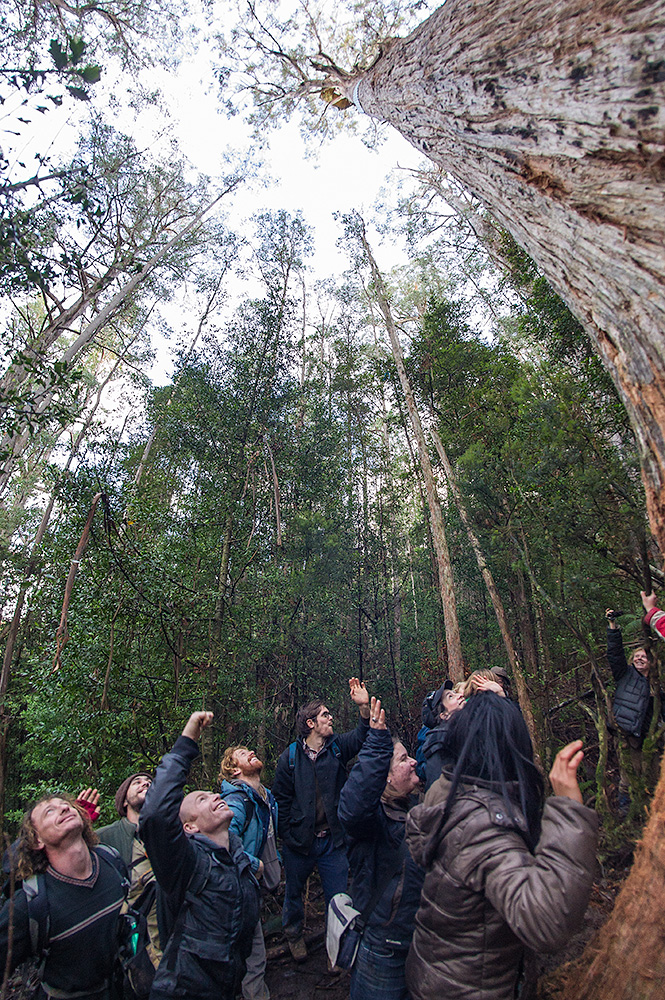 What a great weekend! Thank you to all the people who came out to visit me on Saturday as part of the community walk. It was such an inspirational day to receive so much support. I can’t express how much it means to me to have you all come and visit my tree! And even though I obviously can’t talk to you face-to-face, it was an incredible experience to chat on the walkie-talkie to so many people.
I hope you enjoy this little video I made about the day:
And check out these photos by Alan Lesheim:
Tasmania’s forests still falling: watch the brand new film!
Tasmania’s magnificent forests are still falling every single day as Japanese companies continue buying product sourced from the ongoing destruction.
From the frontline, where the forests are being logged and supplied to Ta Ann’s mill, we have filmed the cycle of forest destruction that is occurring right now in Tasmania’s wild forests. Watch it below, and share it with your friends! The film is also available with Japanese commentary and can be viewed HERE.
572,000 hectares of forest in Tasmania are proposed for protection and have been independently assessed by a team of experts. They found that the majority of the proposed reserves “meet one or more National or World Heritage criteria” and “represent the last chance to address and protect many natural heritage values on forested public land”.*
Negotiations are underway to provide protection for these unique forests and a transition to genuine sustainability for Tasmania’s crisis-ridden native forest industry. Meanwhile, the very forests being discussed for reservation are still being destroyed. Disgracefully, a promised moratorium on logging has never been properly implemented.
We have updated our cyber action, so that you can tell Ta Ann’s customers about new evidence of road-making and logging in the pristine forests followed by massive deliberately lit fires.
Take a few minutes to take action for Tasmania’s forests, and then make it doubly effective by sharing the action and our new film with your friends and family and asking them to also send a message.
For more information go to www.taann.net
* Mackey, Brendan (2012). ‘Tasmanian Forest Agreement – Summary Report of Conservation Values.’ Prepared for the Independent Verification Group of the Tasmanian Forest Agreement. March 2012, p. 9.
Guest Blog: Kat Lyons and Super-Possum
I first met activists from Still Wild Still Threatened while at Climate Camp in Aotearoa/ New Zealand in 2009. Camp Florentine was already four years old by the time I first visited in 2010 and became involved in the southern forests campaign. Now it’s May 2012 and it’s still there; and Miranda has been holding out up in the Observertree for over five months already. Through all the vagaries of Tasmanian weather. Throughs tate promises made and broken.
The idea for ‘Superpossum Saves the Day!’was conceived one evening with a friend in one of those ‘..wouldn’t it be great if…!” moments. We filmed it at the recent Camp Floz skillshare and community open weekend during one of the brief sunny spells and in between the intermittent hailstorms. An extremely silly time was had by all,though we had to use a stunt double to play Superpossum at camp, as Miranda obviously couldn’t come down from the Observertree.
But this is a silly film about a serious subject. We shouldn’t have to still be campaigning. We should have been able to pack down Camp Floz months ago and the Observertree should never have needed to be built. Every week that passes means another part of this irreplaceable ecosystem falls into the teeth of commerce and machinery. But we will not just sit back and let these forests go quietly. We will continue to raise awareness of their plight and the companies responsible for this, and agitate for permanent protection. And where necessary we will continue to put ourselves between the forests and their destruction. If I was wearing a hat right now I’d take it off to Miranda because I know I couldn’t do what she is doing. But just like she says in the film, we all need to work together on this. Not everyone has the ability or inclination to live in a tree sit, but there are many ways to be a Superpossum. So join the cyber action (click HERE), tell your friends and colleagues about what’s happening, encourage people to follow Miranda in her Observertree blog, write letters, donate or get involved in local campaigning groups such as Still Wild Still Threatened and The Huon Valley Environment Centre. It’s a big problem but we all need to just do what we can, because it’s too important for us not to win this one.
Guest Blog Bio: Kat Lyons
Kat has been part of the southern forests campaign since she arrived in Tasmania in 2010. This is her first film.


 T h e O b s e r v e r T r e e