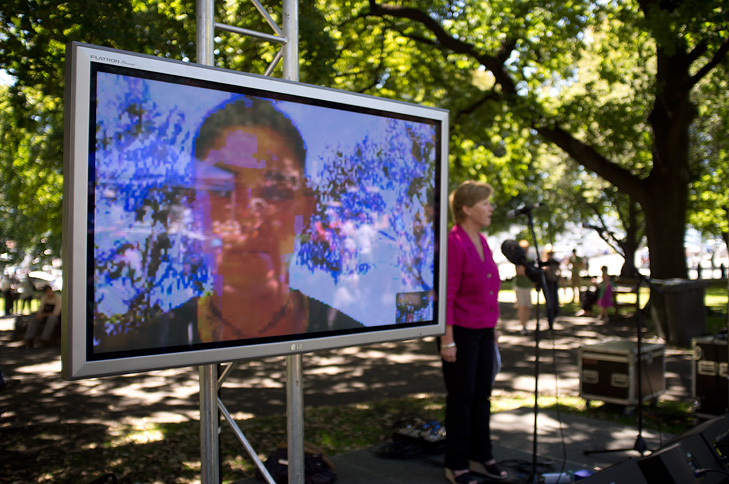
I was beaming! Beaming with excitement and beaming across the net, past these mountains and forests and straight into Parliament lawns in Hobart. What a fantastic experience to be one of the key speakers at the Picnic in the Park event and have the opportunity to tell the crowd of people gathered today all about this area of forest I’m living in. And to encourage everyone to get on board and get active (with a special reminder to people about the upcoming global 24 hours of action coming up on February 15).
The day was a great success with a good turn out and all the technology running smoothly too! I really enjoyed Senator Christine Milne’s speech, in which she raised some questions we should all be asking Forestry Tasmania and the government , in relation to Ta Ann’s wood contract. For example, does Ta Ann only have to pay for the wood that leaves Tasmania on their ships as veneer? This means that all the wood that goes through their gates but which they reject, all the wood that becomes waste product during their processing, all the wood that they do not eventually ship overseas, is never paid for. And why are the details of the contract censored on Forestry Tasmania’s website, when it is a contract that concerns all Tasmanians?
Christine’s media release today requests answers from Forestry to the following list of questions:
” 1.How is it that after Forestry Tasmania lost two thirds of its contracts with the demise of Gunns, that it has to log inside the 430,000 hectares of HCV forests to meet one third of its contracts?
2.Has Forestry Tasmania over allocated the forests?
3.Has Forestry Tasmania massively over cut the forests over a long period of time and would not have been able to meet both Gunns and Ta Ann’s contracts if both were still in business?
4.Does the TA Ann contract only require Ta Ann to pay for the volumes that leave the wharf and not for the logs that are delivered to its plant?
5.Where do the unpaid for rejected logs and waste go?
6.When the Commonwealth gave Ta Ann $10 million to set up in Tasmania , it was to process lesser quality logs hence not from HCV areas, how is it that Ta Ann is now demanding logs from HCV areas?
7.Who changed the specifications of the original contract?”
The speeches were followed by a more informal discussion, giving people from the audience a chance to ask questions. After this I was moved to a new location, a tent where people could come and chat to me individually. It was so wonderful to talk to people about what I’m doing up here, to share ideas, hear people’s thoughts and opinions and to receive message of support. Thanks to everyone that came along today I hope you were inspired by the day as I was!
Here are a few photos from today taken by photographer Alan Lesheim.
Facepainting
Sara Maynard - Tasmanian Aboriginal Council
Senator Chirstine Milne
Vica introduces me to the audience
My moment on the big screen!
Jenny Weber - Huon Valley Environment Centre
Taking part in discussion group
Discussion group audience
And talking on the small screen
For those not in Hobart, sorry that you missed out. But there is always the option of organising something in your local town!
Logging coupe in Tasmania's north west where today's action took place
Ta Ann Tasmania has been put in the spotlight over these past few days, for the role in the continued destruction of Tasmania’s high conservation value forests. Yesterday 25 conservationists entered the Ta Ann veneer mill in the Huon Valley, halting operations and drawing attention to the ancient forest destruction that is occurring to supply wood to this company. Jenny Weber, from the Huon Valley Environment Centre was the spokesperson for the action and stated that “The Tasmanian Government’s own reports show Ta Ann is the major driver for logging in old-growth and HCV forests,”
The concern around Ta Ann’s practises is growing, with more actions occurring today. In Tasmania’s south and also in the north west, actions took place in logging coupes that should have been protected by the Intergovernmental Agreement, yet are now being felled to feed Ta Ann’s mills.
‘The forests we are protesting in today are key targets for Ta Ann’s wood supply. Ta Ann is misleading Japanese customers and the public by peddling misinformation that they receive timber from regrowth and plantation areas in Tasmania only. The Southern protest in the Picton Valley forest is within 2km of a cave system that has indigenous and environmental values of international significance. These forests have never been logged before and conservationists have identified celery top pines that were 150 years old that have been felled,’ Jenny Weber said.
‘The conservation agreement signed on the 13th of January by the State and Federal governments does absolutely nothing to protect Tasmania’s globally unique forests including areas such as these in the North West of the state. It is still business as usual in the forests, with old growth and high conservation value forests tracts still being lost despite being promised protection by the Federal Government in August last year.” said spokesperson for Code Green Jared Irwin. ‘Code Green are committed to ongoing action until Tasmania’s irreplaceable wild forests receive true protection.’
Tasmania devil seen in the area that is now being logged to supply wood to Ta Ann
In addition, Ta Ann was the focus today for environmental NGO Markets For Change (MFC), who publically released a letter they sent to Forestry Tasmania, calling for an admission that Ta Ann is in fact receiving timber from high conservation native forests, contrary to the misleading claims currently being made by Ta Ann. MFC noted that in the annual report of Ta Ann Holding it is cited that Ta Ann Tasmania uses ‘plantation eucalypt.” This is also reiterated on the website of Ta Ann shareholder company Sumisho & Mitsuibussan Kenzai Co Ltd (SMKC) on a page devoted to their Tasmanian product, which states that “We produce there veneer from high-quality eucalyptus plantations…” (http://www.smkc.co.jp/eco/participation.html). Yet this is simply incorrect, as MFC pointed out Ta Ann Tasmania itself admitted that it requires native forest timber, in their submission to a House of Representatives Committee and in evidence under oath to a Legislative Council Committee.
Markets For Change have called on Forestry Tasmania to make a public statement clarifying the fact that Ta Ann is receiving wood from native forests. The letter states
“While the content of its Annual Report it is obviously the responsibility of TAHB, we believe that it is the responsibility of Forestry Tasmania, as the principal supplier of wood to TAT, to be clear and explicit with respect to the source of such wood so that TAHB can be confident of the veracity of statements it makes to shareholders, regulatory authorities, customers and the general public.”
“In the context of current forest conservation debate, the distinction between planted forest (plantation) and naturally regenerated forest (native forest) is highly significant. We believe that TAHB have made a mistake in how they have characterised sources of wood used by TAT mills in Tasmania and that this mistake may have significant market implications.”
It does indeed have market implications. Consumers are likely to believe the product is sustainable if it is labeled “eco” and claimed to be from plantations. Yet, here I am at the top of a tree that is centuries old, in the middle of a spectacular ancient forest that is due to be logged in order to supply Ta Ann with this so called “eco ply.” It is an absolute disgrace that they can place the word “eco” in front of a product that is driving the ongoing destruction of endangered species habitat! These past few days have been inspiring with so many conservationists speaking out against Ta Ann. Please help out by adding your voice at our upcoming Global 24 hours of action on Feb 14-15.
Join us on Tuesday 14th or Wednesday 15th February 2012 to stand up for our forests across the world, support Miranda Gibson’s inspiring ObserverTree action and get logging out of our native forests forever.
Sometimes the actions of one person can inspire thousands of others.
Australia’s world-class forests are still being ripped apart by industrial logging operations every single day. The destruction of our native forests is placing our threatened species, clean air and water, and climate in serious danger.
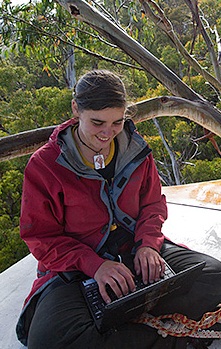
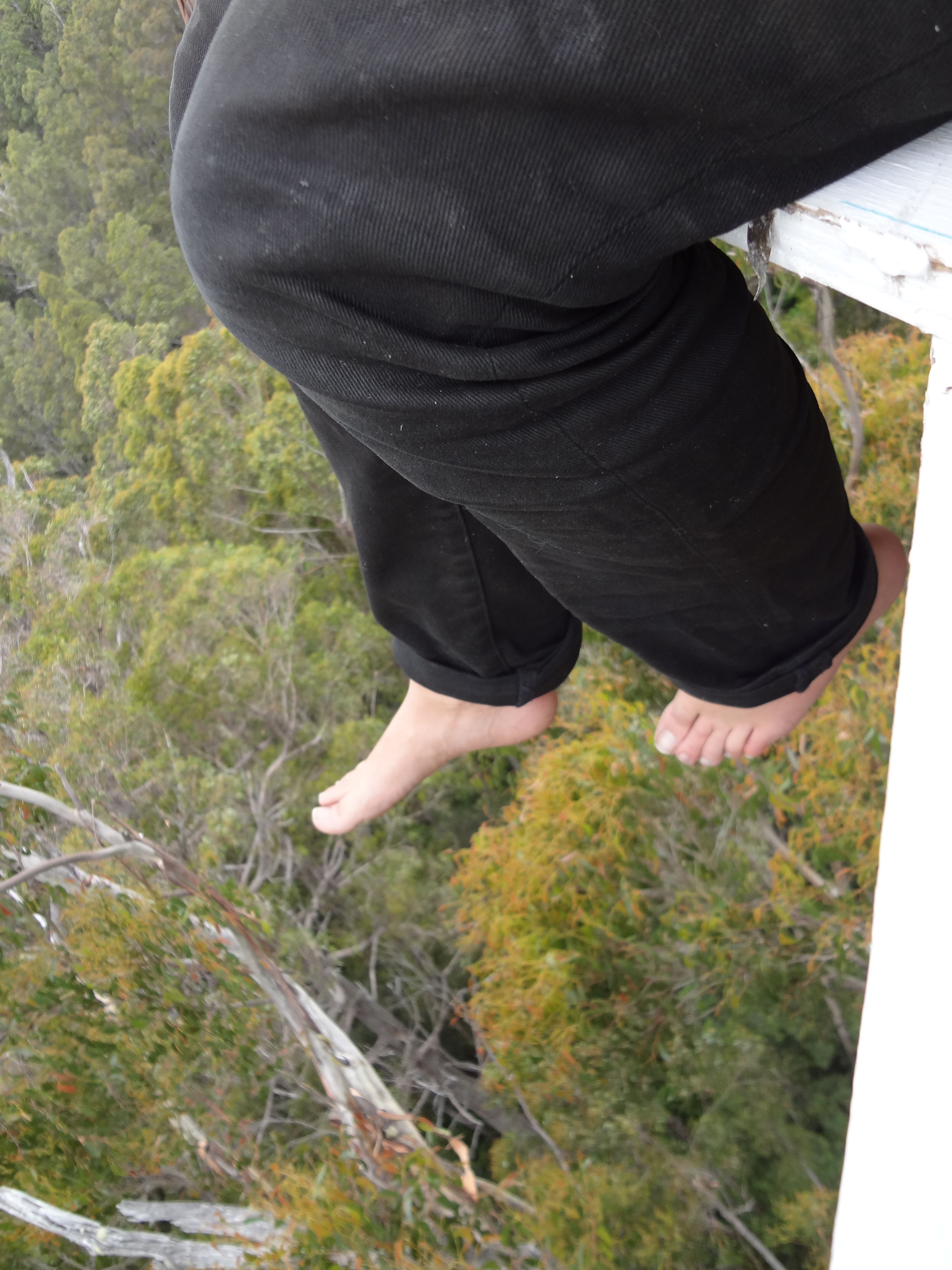
As you read this, Tasmanian forest activist Miranda Gibson has been living on a platform in the ObserverTree 60m high in the tall trees of Tasmania’s western wilderness for nearly 5 weeks. Miranda has vowed to remain where she is until Tasmania’s forests receive formal protection.
Malaysian timber giant Ta Ann has played a key role in ensuring that Tasmania’s forests are not protected. Despite labelling some of its products as ‘eco ply’, Ta Ann continues to receive timber from old growth forests in Tasmania, rejecting timber from plantations. The timber is exported and sold in Japan, China and Europe. To read more about Ta Ann and its forest-destroying activities, check out this great report by the Huon Valley Environment Centre.
The campaign had a major success last month with one of Ta Ann’s customers UK company International Plywood cancelling its wood contract after hearing about Tasmanian forest destruction. Now it’s time to call on Ta Ann’s major international customers, based in Japan, to follow suit and stop buying wood from our precious native forests. The recent success shows that change is possible. These companies hold the key to forest protection in Tasmania.
We need your help to send a clear message to Ta Ann and its customers that Australia and the global community will not accept native forest destruction!
International support has played a key role in our campaign so far. When Tasmanian forest destruction is being exported all over the world, it’s really important to have a worldwide response.
This is a growing campaign and actions have happened from coast to coast in Australia. We need your help to send a clear message to Ta Ann and its customers that the global community will not accept native forest destruction!
Take a stand for our spectacular forests and join us right across Australia on Tuesday 14th – Wednesday 15th February 2012 to take part in a massive 24 hours of action that is happening around the world.*
It’s easy to take part in this global 24 hours of action! There are two things you can do:
1. (The simple option)
All you need to do is gather a few friends, paint a banner that says ‘Tasmania’s forests still falling’, photograph yourselves with it and email us the photo. We also have posters and fliers we can send you with a bit more information about the campaign and things people can do to help.
2. (If you can do something a bit more technical)
Get hold of a good projector and project some of Miranda’s footage of the forest (which we can send you) onto a wall in a prominent location – the bigger the image the better! If logging has started we will send you footage of logging, if not we will have other images of the forest and the species that live in it. We are really excited about this aspect of the action as we think it will communicate the forest destruction to passers-by in a very powerful way.
We’re really keen to raise as much awareness as possible about this huge action, so if you could help us with spreading the word, that would be ace!
Please contact us right away on observertree2011@gmail.com if you would like to take part in the action, put posters up in your area, or help us with promotion, and we will send you more action details via our super sonic electro carrier pigeon.
For the forests,
Observertree crew
* Because of differences in time zones, the action will be held over 14 & 15 February (Weds 15th Feb in Australia). Contact us at observertree2011@gmail.com for more info.
This coming Saturday conservationist Miranda Gibson will bring the forests to town and beam live from her tree top perch to talk to at a family picnic event in Hobart.
The Picnic in the Park, a family day being held on Parliament Lawns on January 28th, is a celebration of Tasmania’s forests and those working to protect them. Miranda, who has been living in a tree for almost 6 weeks now, is a key note speaker at the event, will participate in a dicussuion group and talk one-on-one to picnicers via a live web-stream.
“Networking Tassie’s threatened forests to the world, from the forests themselves and the ObserverTree is really capturing peoples imagination and this opportunity to talk live to a crowd via the internet is a new one for the forest campaign and I’m really looking forward to it,” said Ms Gibson.
A large screen will be set up on Parliament Lawns to beam Miranda and her forest protection message into the event. Other speakers include Greens senator Christine Milne. The event will also feature a series of discussion forums on topics such as conservation science, the forest Intergovernmental Agreement and the politics of freedom. Miranda will also be a participant in one of in these forums.
“It’s been almost six weeks now since I set foot on the ground. I am determined to stay at the top of this tree until the forest is protected. This weekend is a great chance for the community to come together in a celebration of the forests and to discuss the issues surrounding the forest debate in Tasmania,” said Ms Gibson.
The family day will also include stalls, children’s activities, circus, workshops and hot food. The day is being organised by a coalition of environment groups including Still Wild Still Threatened, The Wilderness Society, and Huon Valley Environment Centre.
“The Governments’ failure to protect our forests in line with their Agreement points to an even more urgent need for the community to work together and help hold them to account. People need to see meaningful forests protection if the much-anticipated peace in the forests is ever going to be realised and this will be my main message to the Picnic in the Park,” siad Ms Gibson.
Event Details:
Picnic in the Park: Bringing the forests to town. Saturday 28th January 2012. Parliament Lawns Hobart. 11 am to 4 pm
(speakers at 11.30 am and discussion groups from 12.30pm)
I tried to block out the thought as soon as it entered my mind. I didn’t want to think about it. But it kept creeping back to me. I imagined that one day someone else would be sleeping in this tree. Not like I have been every night for the past six weeks, looking out across the mist covered mountains and the Tyenna Valley. No, not out here in the middle of this forest. But in this tree non-the-less; after it has been hacked into pieces, shipped across the world to China and back, sold at a Harvey Norman store as a “Tasmanian Oak” bed, finally ending up in the bedroom of someone out there who lays down to sleep, perhaps unknowingly, in The Observer Tree. No, I don’t want to think about that, it is too horrible.
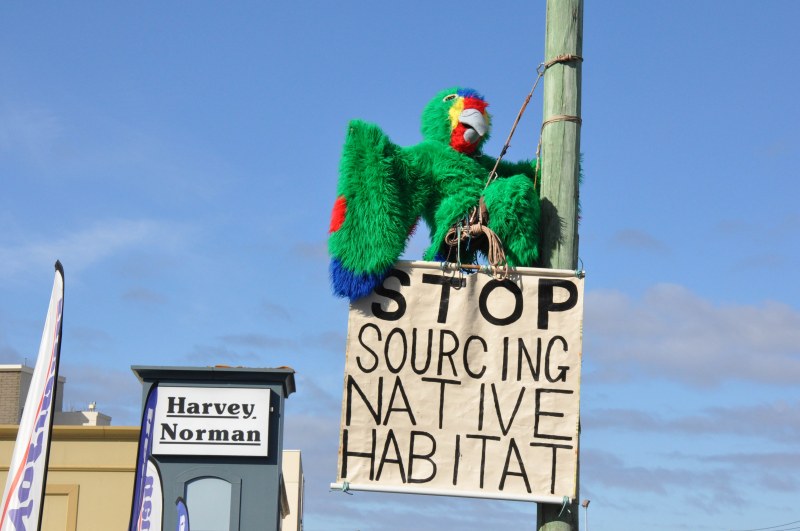
I remember when I first walked into a Harvey Norman store with new eyes, full of a new found awareness of where each table, chair and bedframe had come from. In July 2011 Markets for Change (MFC) released a report entitled No Harvey No. It mapped out the chain of custody of native forests logged in Tasmania, Victoria and WA, as it is shipped to China, made into furniture and shipped back to Australia. It took a year for MFC to track the complicated journey that the timber takes once it is taken from our forests. For example, one chain of custody involves Chinese company E-JEYIK which buys the wood from Auswest, Britton Timber, and Gunns Ltd, turns it into furniture sends it to wholesaler Dixie Cummings, who then sells it on to Harvey Norman.
“Many of these retailers like Harvey Norman have very large advertising budgets. Every time their advertising lead to the sale of a timber product from a native forest it directly contributes to the logging of these forests. Yet many companies such as Harvey Norman, have no publicly available procurement policies” It states in the MFC report.
This is why I was walking through a Harvey Norman store, looking in detail at each label. No, I wasn’t looking to buy a new bed; I just wanted to see for myself. And there it was “Tasmanian Oak” written on labels on beds, tables, cabinets. I ran my hand along the top of a table. Taking in each grove, each marking in the wood. It suddenly occurred to me that anyone of these could be Front Sit. In the past I had imagined trees I’d come to love, being split into a million pieces, turned into woodchips, spread in a million directs, lost amongst tiny pieces of other trees, other forests. Finally ending up scattered across the globe, as tiny specs in a piece of paper in America, a tissue in Japan, cardboard packaging in France, some toilet paper in China. It was almost like scattering the ashes of a loved one into the wind, watching them blow away. But as I stood in front of this solid table, it somehow made the heart ache feel more real. The reality that an Australian family out there somewhere might be eating their dinner off the corpse of Front Sit tonight. I gently touched each table, each bed, the back of each chair. “Victorian Ash,” “wormy chestnut” and “Tasmanian oak” – imagining the trees, the forests from which they had come. Taking a moment to honour the life that they had been, because I figured that whoever bought them would never know the truth.
The sadness I felt inside the store gave way to other emotions. For the first time in a long time I felt a renewed sense of enthusiasm and excitement for the forest campaign. I had just about had it with the forest negotiations going nowhere and the government bowing down to companies instead of listening to its constituency. I just didn’t know what to do or how to change things. I really wanted to see these forests saved but I was out of ideas and I just felt like we were getting nowhere. And then it happened. If this was a cartoon the No Harvey No report would be like a light bulb suddenly appearing above my head! Armed with the new realisation that the government was not the only ones that controlled the fate of the forests and not the only ones who could change it, I couldn’t wait to start putting the heat on Harvey Norman, and seeing if we could get Gerry to change their procurement policy. If Harvey Norman stopped sourcing wood from Tasmania and other native forests, then that would have a major impact on the industry. Adding the extra pressure needed to force the whole forest industry to change.
Like MFC said in their report: “As Australia’s largest retailer of furniture and electronics in Australia, Harvey Norman, its management and its shareholders have a special responsibility to source products in an environmentally responsible way.”
Since the campaign was launched less than a year ago, there have been loads of actions right across the country and even across the world, targeting Harvey. Yet, the company hasn’t changed their policies. I guess we have to keep at it!! Every time someone walks into a Harvey Norman store and asks about the policies, every time their company name is mentioned in the media in relation to forest destruction, every banner drop, every poster, every e-petition: they add up and bit by bit they no doubt worry Gerry Harvey, that his brand name is being damaged. His brand name is now associated with forest destruction. And eventually, if we keep this pressure up, he will have no choice but to listen to the people and change his policies.
Recently Get Up! had a campaign where everyone could take a copy of the petition that was signed by nearly 50,000 people, and hand it directly to the manager or franchisee at your local store. I went along with my Mum to her local store in Capalaba, Queensland. As soon as we took out the petition the manager saw it out of the corner of her eye and she knew what it was straight away…it was quiet clear that she had been waiting and expecting this moment. Possibly we weren’t the only ones dropping the message into that store. The fact that she knew all about it was an inspiring sign. It shows that the company is definitely feeling the pressure.
I’d like to say to Gerry Harvey: Despite what the Tasmanian Government may have tried to tell you, the forest issue in Tasmania is not ‘getting sorted.’ Logging of high conservation value forests continues as rapidly as ever, fueled by companies like yours. So long as Ta Ann and you, Mr Harvey, continue to buy and sell these products made from our native forests, there will be no “peace in the forests.” And there will be no peace in the show rooms either, because more and more people are realising where these products come from. And how many people really want to sleep a bed made from the corpse of a 400 year old tree?
Check out the films below of actions targeting Harvey Norman.There’s lots of great ones choose from, so I’ve just picked a couple. I hope it inspires you to get out there or get online and take action!
This photo essay by renowned wilderness photographer Rob Blakers shows the beauty (and destruction) of Mount Mueller’s forests. These photos were taken in the logging coupe Tn44B, where the Observer Tree is located, and the forest surrounding it. All these images were taken within the 430,000 hectares that was promised protection by the Australian Government, that is ear-marked […]
“You must be really getting to know this forest by now” My friend said to me the other day, after she climbed up to see me and we sat looking out over the tree-lined ridges that have become my daily view. “I look at that patch every day and wonder what it’s like to walk to through there.” I say, pointing to the place where the colour and shape of the trees change, “I always wonder what is happening over there, why there are no eucalypts in the patch, as the forest gives way to a small area of sassafras and other rainforest species.” My friend has just arrived for a visit. We are looking out across the view, as she recovers from the 60 meter climb “you must be really getting to know this forest by now” she says.
It feels strange to think of ‘knowing’ that forest, when I have never set foot on that patch of ground. In a way, I wish I had the chance to get to know it better. Walking along these ridges, getting to know the twisted sassafras trees, the stands of celery top pine, the creeks and gullies. But instead, I feel stuck up here, watching from a distance. But in some ways, my friend is right. I am getting to know this forest, from a different perspective than usual. I’m getting to know it the way birds probably know it, looking out over the tree tops.
My friend tells me the story of a plane crash 70 or so years ago, near where she lives… A plane went down in dense forest. Incorrect sightings lead the search party to look in the wrong place. There was a man who lived in an area overlooking the forest. He knew the forest so well that he could tell in the distance that a few trees were missing in a particular patch. So, on a hunch that the plane might be there, he headed off on a two day hike through the bush. He was able to locate the plane, managing to save the two survivors left there. “It’s funny,” my friend says “lots of people look back to those days and think that the people weren’t as environmentally conscious as today, that all they saw in the forest was timber to utilise. But this story shows that people living on the land have a connection to the land. They knew it like the close companion”
The story fascinated me. I wondered, looking out across the forest, if I would notice a few trees missing in the distance? I wondered if I could know my way walking through that forest, just from watching it day in and day out from this perspective. I eagerly researched the plane crash that night on the internet. It’s a very interesting story. I couldn’t find evidence of the fact that noticing missing trees in the distance was the catalyst for the hero of the story, Bernard O’Reilly, to look for the plane. But, either way, that seems to be the story that has lived on through word of mouth. In his evidence to the inquiry about the crash, O’Reilly says that when he was looking for the plane, he figured that it would have burnt as it crashed. He notices flowering trees that were slightly cream, instead of the usual white and headed in that direction, thinking it may be evidence of fire, eventually finding the plane in that direction.
His daughter explained his humble attitude, he didn’t consider himself a hero; he just did what needed to be done. She said “He thought that if there were people who needed saving and it was fate or whatever you like to call it, needed them saved, they wouldn’t necessarily send miraculous means, but his thought was that they would give the idea to someone who had the knowledge to carry it through” [http://australianetwork.com/nexus/stories/s1878075.htm]
I admire his humble approach and his idea that ‘fate’ wouldn’t fix things miraculously, but give people the idea to do it. I wonder if this is how things are with the forest too. That there is no miraculous thing that will save the forest from destruction. Maybe ‘fate’ will just place the idea into people’s heads that it needs to be done. The question is then, if people will act on that? As O’Reilly acted on his thought back in 1937 to search for that plane.
Someone who has been following my blog sent me an email the other day about an elderly person at the checkout. The young cashier critical because they didn’t have a green bag, implying the older generation were less ‘green.’ The response being a list of all the things people used to do in the past (walking instead of taking the car, doing things by hand, reusing things etc).
It makes me think of conversations had around the fire at Camp Floz on those nights that we were visited by a couple of ex-loggers. They certainly wouldn’t call themselves ‘greenies.’ But they were critical of today’s logging industry… Back in the day, they said, it took all day to fell a giant tree and then even longer to get it out of the forest. Logging this way, they reckon, gave them a different respect for each tree. They compared this to the smash and grab of modern logging, machines wiping out hectares and hectares in barely no time at all. 400 year old trees felled in 15 minutes. In combination also with new processing methods plus the rise of the demand internationally, these old tree-fellers were gravely concerned with the rate of destruction occurring. It’s being logged too quickly, we are losing too much forest, they’d say.
In some ways there seems to be an ever increasing awareness of the need to protect the environment. The world seems to be becoming increasingly ‘green’ but this seems to be matched with an increase in destruction, in production and consumption, and the technology to destroy the environment at an ever increasingly rapid rate.
In another 70 years, when they look back on our stories, what will they say about us, about how we treated the land? I hope that future generations can look back at this time, in 2012, when the international community stopped sourcing wood products made from old growth and primary forests. I hope that one day people will be celebrating the protection of the world’s forests.
For those of you in Tasmania, this weekend is a great time to celebrate forest activism, because the Huon Valley Environment Centre is turning ten! And to commemorate this milestone, they are have a festival down at Lonnavale.
This volunteer run organisation has been a critical player in the forest campaign for the past ten years. Tirelessly defending the forests of the Huon Valley, this group have brought the beauty and the ongoing destruction of these forests to the attention of the world. They have led the charge in the fight to free the forests from the hands of Ta Ann. Recently Jenny Weber spokesperson for the group travelled to Japan to talk to customers buying Ta Ann’s wood made from our precious native forests. We’ll be hearing more from Jenny in her guest blog…coming soon!











 T h e O b s e r v e r T r e e