Australian tree sitting record broken today!

Today, Miranda Gibson breaks the Australian record for the longest tree sit. Miranda has remained at the top of a tree, 60 meters above the ground for 209 days, in protest of the ongoing logging of Tasmania’s high conservation value forests.
“I climbed to the top of this tree over six months ago and made the commitment to remain here until the forests are protected. Unfortunately these globally significant ecosystems have remained under threat and I have needed to maintain my vigil for 209 days” said Miranda Gibson.
“This is a significant milestone to reach, and this is now the longest running tree sit in Australian history. However, I sincerely hope for the sake of these high conservation value forests that protection is secured soon and I can come down from the tree” said Ms Gibson.
“The failure to stop the destruction of all the independently verified high conservation value forests and the continual delays in negotiations has caused enormous community concerns, raising question as to whether a resolution will be reached in the near future that secures real forest protection” said Ms Gibson.
“My presence is this tree has acted as a constant reminder for the past 209 days that verified world heritage and national heritage value forests are being lost, primarily due to Ta Ann’s wood supply specifications” said Ms Gibson.
“I have been in communication with the corporate customers of Ta Ann, to inform them of the conservation values of this forest and the need for Tasmania to move forward to a sustainable forest industry through the protection of high conservation value forests” said Ms Gibson.
“The Observer Tree has drawn international attention to the values of the forests that are currently threatened by logging. From the tree tops I have used http://www.observertree.org to connect to the world; updating a regular blog and conducting talks around the world via Skype.” said Ms Gibson.
“I am committed to staying at the top of this tree for as long as it takes to see Tasmania’s precious forests given the protection they deserve” said Ms Gibson.
Click HERE and take action for Tasmania’s forests now!
A forest a day! 9 July: SX028J, Styx Valley
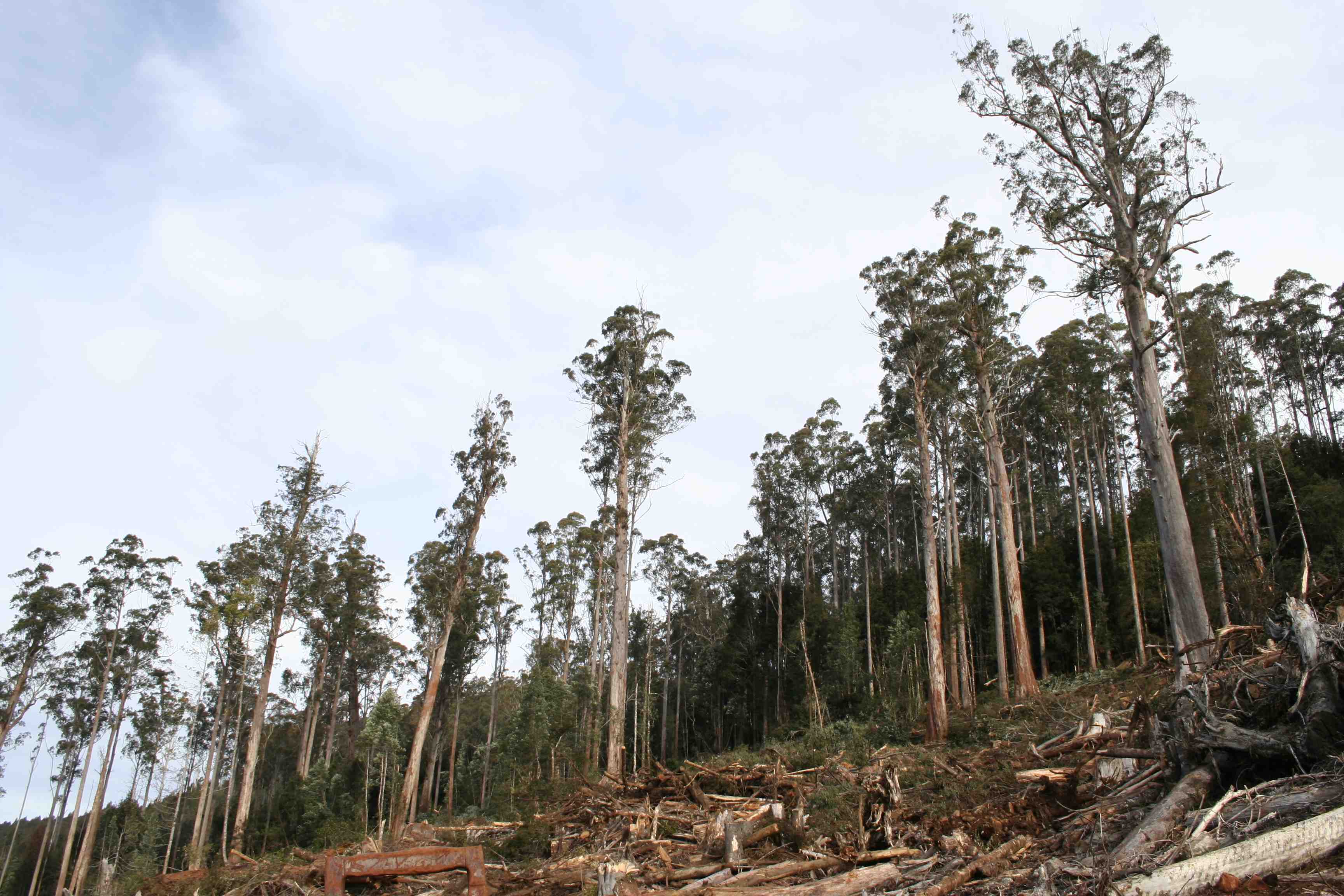
Current logging operations in SX028J, Styx Valley
The spectacular forests located in coupe SX028J are currently being destroyed by logging operations. This tract of forest was formerly populated with giant eucalypt trees, a number of which had visible hollows. Below the upper canopy was a thick rainforest understorey consisting of myrtle beech, celery-top pine, sassafras and tree ferns. Mapping data indicates a wedge tailed eagle nest in the vicinity of SX028J, and also identifies this forest as quoll habitat.
Immediately adjacent to a reserve, SX028J’s high conservation value has made the logging of this forest highly contentious. A number of community protest actions took place when the first section of this coupe was logged last year, at a time when it should have been protected by a moratorium. An additional section of this forest is being logged right now.
These images, taken yesterday, show the immense size of the eucalypts in this forest as well as the clear felling that is currently occurring in SX028J. The trees in the foreground and the forest behind them will be felled in the coming days or weeks.
The much anticipated forest agreement will not come in time to save this magnificent forest from logging operations.
Please take action HERE to protect the remaining spectacular forests of the Styx Valley and other threatened forests right across Tasmania.
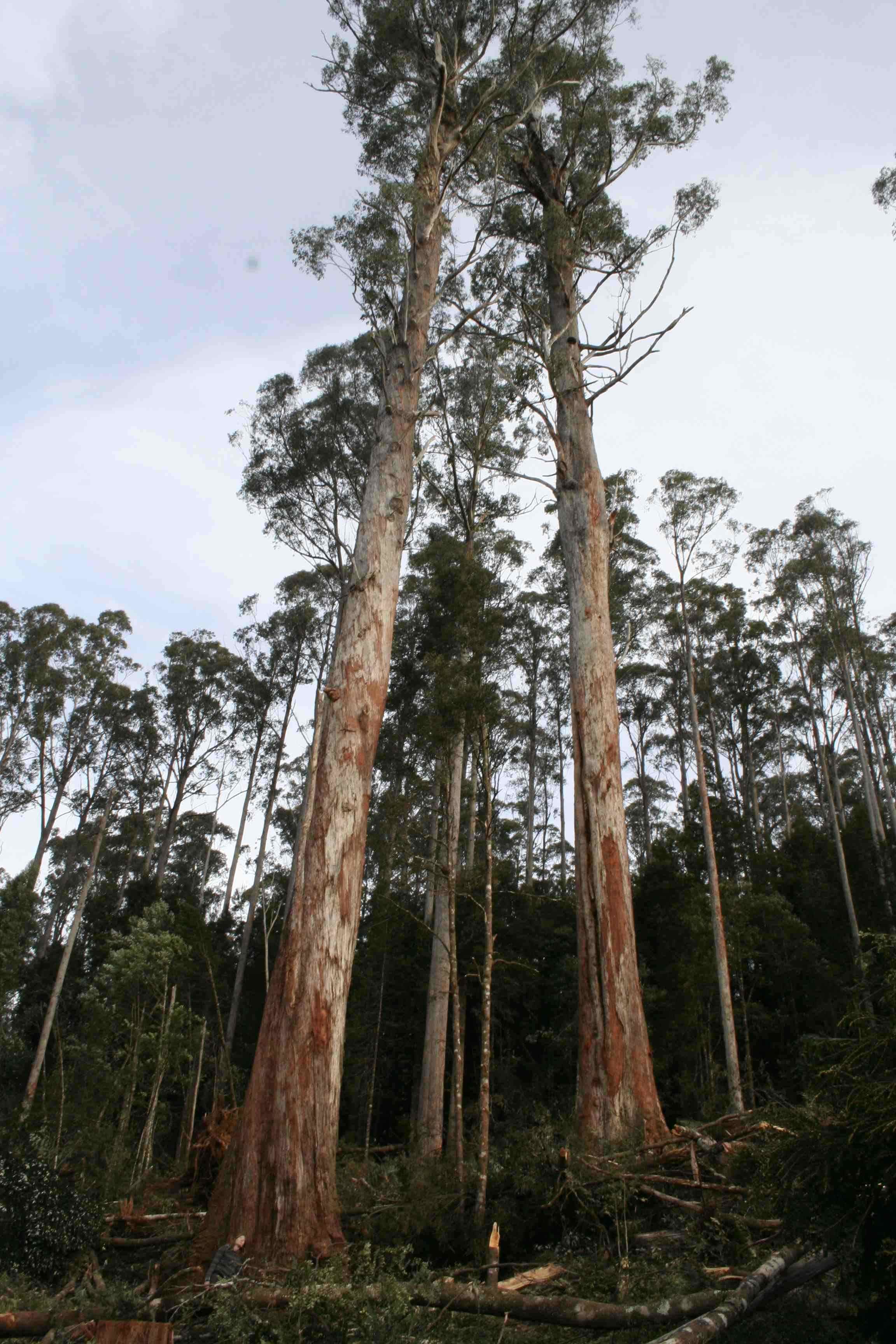
These giant eucalypts, located in SX028J, will be logged in coming days or weeks.
For more information about the ‘A forest a day’ project, which is a collaboration between Huon Valley Environment Centre, Still Wild Still Threatened, The Last Stand, Markets for Change and Code Green, please click HERE.

Media Alert: Tasmanian tree sit breaks Australian record tomorrow
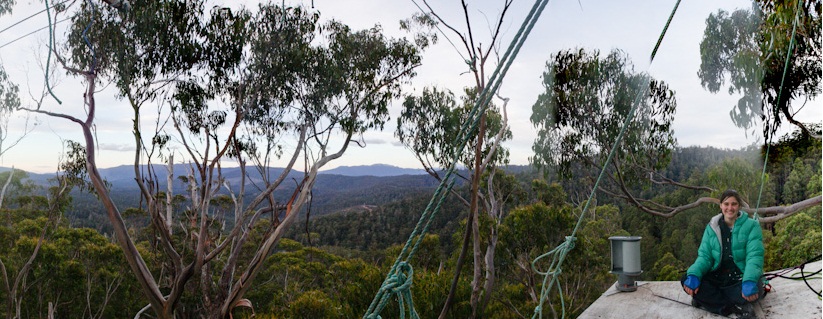
Miranda Gibson in The Observer Tree: Photo by Paul Hoelen
Tomorrow, conservationist Miranda Gibson will break the Australian record for the longest time spent continuously in a tree sit. Miranda, spokesperson for grassroots group Still Wild Still Threatened, has been perched at the top of a eucalypt tree in Tasmania since December 14th 2011, in an area of forest under threat from logging.
Miranda is set to break the record tomorrow when she reaches 209 days atop the platform known as The Observer Tree. The previous record holder was Manfred Stephens, who spent 208 days in a tree sit near Cairns in 1995.
This milestone comes at a time when environment and industry groups are in their last weeks of negotiation, with a final chance to seal a deal for forest protection under the Intergovernmental Agreement by July 23rd 2012.
A forest a day! July 8: BB021C, Lower Weld Valley

BB021C before logging operations began in 2006. View from Glovers Bluff
Logging coupe BB021C, located in the lower Weld Valley, Is an area of forest that was left out of the conservation agreement and which was first logged in 2007. This logging operation was the first incursion into the wild Eddy Creek catchment, and commenced after the removal of the Weld Ark community blockade, which was stopping logging activity in the area and featured a full-sized replica pirate ship built on the road.

Weld Ark community blockade halting logging in the Lower Weld Valley in 2006
Logging continued in the coupe during 2011, and BB021C remains unprotected by the conservation agreement due to further plans to log this spectacular area.
BB021C was a community of mature wet forests – Eucalyptus regnans, tall Eucalyptus obliqua and mature blackwood – which contained suitable habitat for threatened species such as the white bellied sea eagle, wedge tailed eagle, grey goshawk, masked owl, eastern quoll, Australian grayling and eastern barred bandicoot (1).
The nearby Barnback Creek is a known location for the Little Denison crayfish, a threatened species that is endemic to this region (2).
The forested region of Barnback and Eddy Creek catchments contain Acacia melanoxylon forest on flats, and areas of Acacia melanoxylon swamp communities. These swamp communities are a nationally uncommon plant community— essentially confined to Tasmania— and now a rare aspect of Australian vegetation (3).
Please take action HERE to protect the spectacular forests of the Lower Weld Valley and other threatened forests across Tasmania.
For more information about the ‘A forest a day’ project, which is a collaboration between Huon Valley Environment Centre, Still Wild Still Threatened, The Last Stand, Markets for Change and Code Green, please click HERE.
References …
(1) Forestry Tasmania, Forests Practices Plan, 12 Nov 2006.
(2) Forestry Tasmania, http://www.forestrytas.com.au/uploads/File/pdf/foi2008/FOI08-3.pdf
(3) Hitchcock (2012), IVG Report 5A: Verification of the Heritage Value of ENGO proposed Reserves, p. 245 [View online]

A forest a day! July 7: DU021B

This recently logged 96 hectare coupe is within an area north of Mount Field National Park (MFNP), that has been recommended to be added, along with the current National Park, to the Tasmanian Wilderness World Heritage Area (Hitchcock 2012: 128).
The boundary of MFNP in the north is a straight line that cuts across the landscape and topography of the area. Hitchcock states that this is “far from ideal.” (Hitchcock 2012: 136). Hence, these recommended additons would greatly improve the current reserve design.
One purpose of including the lands surrounding the Park is to strengthen the values of the current protected area. A more suitable boundary has been recommended by Hitchcock which takes into account a range of factors including protection of cave systems, catchment areas for those cave systems, connectivity of tall eucalypt forests, and natural features in the landscape (Hitchcock 2012: 135). DU021B is within this proposed extension.
“The ENGO proposed reserves associated with MFNP are an integral part of the larger assessment area and take their high conservation significance from being part of that larger block” (Hitchcock 2012: 132). MFNP has significant world heritage value, including remarkable glacial features and extensive cave systems.
Yet despite these recommendations, logging has proceeded in this area. With forestry operations occurring in such close proximity to the boundary of MFNP, the conservation values of the protected area are put at risk. We are calling for an immediate cessation of logging and roading operations within the forests that are proposed for future reserves.
Please take action HERE to protect Tasmania’s precious forests.
For more information about the ‘A forest a day’ project, which is a collaboration between Huon Valley Environment Centre, Still Wild Still Threatened, The Last Stand, Markets for Change and Code Green, please click HERE.
References:
Hitchcock (2012) IVG Report 5A: Verification of the Heritage Value of ENGO proposed Reserves [View online]

A forest a day! July 6: BB021E
A proposed new road and logging coupe in the Barnback Creek region has the potential to destroy the values of a previously unroaded forest area in the Lower Weld Valley. However, there is still time for these forests to be protected as logging has not commenced yet.
Barnback Creek, located in southern Tasmania, flows through wet fern-filled forests into the Weld River. A new 2.5km road and logging area of 70 hectares is planned for the northern flank of the creek, which would destroy significant stands of Eucalyptus regnans and Eucalyptus obliqua.
Forestry Tasmania plans to cable log the area. The Federal Government’s inadequate conservation agreement left this area open for logging. This forest is a spectacular mixed aged eucalypt forest.
In 2006 a new logging road was built named Eric Pettets Road. After 16 months of direct action by peaceful protesters who blockaded the proposed road extension with a spectacular Weld Ark, the road was pushed further into the previously unroaded area. More than 50 people were arrested in the ensuing protests. Two areas of forest have been logged along this road.
The new proposed road would push in to previously unlogged forest off Eric Pettets Rd.
Barnback Creek is a 6km tributary of the Weld River. During the community blockade and since, thousands of people visited the area, explored the forests, studied them and defended the forests from logging on the frontline.
This significant roading operation was due to commence in January 2012, and then logging was to commence this winter. These forests will go to feed the mill of Malaysian logging giant Ta Ann.[i]
The delay for this new road and logging operation means that these forests still have a chance to be protected.
BB021E is in a sea of Dixonia antarctica or manferns. This species is very slow growing, between 1 – 10 cms a year depending on the conditions. It can live up to 1000 years and the trunk of tree ferns provide habitat to the twelve species of Tasmanian epiphytic ferns.[ii] Dicksonia antarctica is a very important component of the Tasmanian bush. It is extremely hardy and tolerates temperatures from -10 degrees celcius to 40 degrees celsius, prefers fertile organic soils and moist, humid conditions with some shade. The tender and fleshy croziers (the young, uncurling fronds) can be a food source for native animals such as possums and parrots.[iii]
Please CLICK HERE and take a moment to help defend Tasmania’s forests.
For more information about the ‘A forest a day’ project, which is a collaboration between Huon Valley Environment Centre, Still Wild Still Threatened, The Last Stand, Markets for Change and Code Green, please click HERE.
For more information on Barnback forests: click HERE.
[i] Hoffman, O. 23 December 2011 Rescheduling Work – January and February 2012, As requested by The Australian Government 21 November 2012 [view online]
[ii] Gibson, M, & Leahy, L., (2010) Flora and Fauna Guide to the Upper Florentine Valley.
[iii] Richard Barnes, Department of Primary Industries and Water [view online]

A forest a day! July 5: SX020G
SX20G is located in Tasmania’s iconic Styx Valley. These forests are known best for their signficant stands of tall trees. In fact, the Styx Valley is home almost 30% of Tasmania’s recorded “giant” trees (Hitchcock 2012: 98). Most notable are the Eucalpytus regnans, the tallest flowering plant in the world. Hitchcock notes that the Styx not only features giant trees, but also provides the right ecological conditions for potential future giants (Hitchcock 2012: 98).
One of the key reasons why this area should be protected is to maintain regional connectivity. As it is a major node in the corridor of globally significant eucalypt forests stretching north-south (Hitchcock 2012: 96).
This forest features tall eucalypts with a diverse understorey. Extensive stands of myrtle and celery-top pine are present.
This coupe is also within an area mapped as potential grey goshawk habitat. This species is listed as Endangered (Tasmanian Threatened Species Protection Act 1995), due to the continuing decline of mature individuals (FPA 2008: 10). According to the Forest Practices Authority a high proportion of the core habitat for this species is in areas that are not protected (FPA 2008:10). Goshawks generally prefer forest with a closed canopy and low stem density, particularly during nesting season. While further study needs to be done on their hunting patterns, it is believed that interconnecting forest areas of 20-30km squared are required to sustain a population and that mature wet forests are their prefered hunting areas. The Forest Practises Authority also states that “one of the key threats for the grey goshawks is widespread native vegetation clearance” (FPA 2008: 10).
While SX20G is within the 430,000 hectares due to be in a conservation agreement in August last year, the coupe remains open for logging. This coupe is being logged to produced saw logs and veneer (Hoffman 2011: 8). Logging has not begun in this coupe, and there is still time to ensure that this forest is protected.
Please CLICK HERE and take a moment to help defend Tasmania’s forests.
References:
FPA (2008) FPA Planning Guide 2008/1
Hitchcock (2012) IVG Report 5A: Verification of the Heritage Value of ENGO proposed Reserves [View online]
Hoffman, O. 23 December 2011 Rescheduling Work – January and February 2012, As requested by The Australian Government 21 November 2012 [View online]

A forest a day! July 4: TN046A
This 27 hectare coupe is situated at the base of Mount Mueller, near the Styx and Tyenna Valleys. There is a magnificent walking track that takes visitors up the mountain to a glacial lake called Fossil Lake. This track is located right in the middle of the area scheduled for logging.
This forest contains examples of western peppermints and snow peppermint gums with a mature rainforest understorey. Sassafras, myrtle, celery top pine, horizontal and leatherwood are common throughout the area. There are also substantial areas of pure rainforest present on the site and significant stands of native laurel. Other areas within the coupe are populated with mature tea trees, pandanii and heath.
This coupe is within 700m of the current Tasmanian Wilderness World Heritage Area. Hitchcock concludes that the Styx-Tyenna assessment area in which TN046A is located “would not only make a major contribution to the value and integrity of the TWWHA in respect of tall eucalypt forests but also facilitate maintenance of regional connectivity” (Hitchcock 2012: 100).
This forest is within an area identified as having potential karst systems, based on data from the Tasmanian Karst Atlas (DPIPWE 2010). Hitchcock noted this in his report, stating “there is significant mapped karst within the ENGO-proposed lands.” (Hitchcock 2012: 101)
Still Wild Still Threatened have surveyed the area for wildlife using remote sensor cameras. Threatened species including Tasmanian devils and spot tailed quolls have been recorded within the coupe. There are also significant areas of mapped grey goshawk habitat in the surrounding areas that occur within a kilometer of this site.
Logging has not yet begun in this coupe. However, with the extension of the current inadequate “conservation agreement” it remains excluded from the moratorium and as such, under imminent threat of destruction. TN046A is on Forestry Tasmania’s logging schedule for this year. Please help ensure that this world heritage value forest is protected from logging. CLICK HERE to take action now.
Check out this film featuring the Mount Mueller area, including TN046A and TN044B (where Observer Tree is located)
References:
DPIPWE (2010) Tasmanian Karst Altas (Version 3.1)
Hitchcock (2012) IVG Report 5A: Verification of the Heritage Value of ENGO proposed Reserves [View online]
For more information about the ‘A forest a day’ project, which is a collaboration between Huon Valley Environment Centre, Still Wild Still Threatened, The Last Stand, Markets for Change and Code Green, please click HERE.
Miranda’s Daily Blog: Day 203
Who can complain about a day in the office with a view like this? What an amazing place to spend time writing about the forests, while looking out across snow-covered mountains! I must admit, I did get a little distracted taking all these photos instead of doing work on the computer! I hope you enjoy the slide show:
Miranda’s Daily Blog: Day 202
Sometimes life up here feels full of good-byes. Maybe that is how life goes, hey?
I stood looking down through the trapdoor in my platform. I watch as one of my best friends disappeared down the rope, getting and smaller and smaller. I step away and when I look back the rope dangles lifelessly towards an empty patch of mud beneath the tree. He is gone. Another good-bye.
I guess if I wasn’t in this tree I’d still have to say goodbye. I’d still have friends that decide to move away from this island. But some how it seems harder up here, because every good-bye is followed by isolation. It’s just the forest and me, quietly contemplating solitude.
It’s interesting how the solitude of this experience has at times been one of the hardest things and at other times one of the most incredible aspects of life up here. I have had more time to myself then I ever have and probably ever will. It’s been plenty of time to reflect on life. There is something special about the feeling of it just being me and the forest here. No one else in sight for kilometers. To be here in the peacefulness of the forest, listening to the birds, and coming to understand the forest in away that can only be done quietly and over time. The Observer Tree has turned out to be a personal journey for me as much as a public campaign.
On the flip side is the challenge of loneliness. I miss being around people, laughing with old friends and making new ones, being part of a community. I have learnt to enjoy my own company, but as you can imagine, it’s not always enough. And I guess the hard thing is that visits from friends (and recently my Mum!) always feel too brief. They are here and then they are gone. It feels strange to watch them go and know I can’t leave.
The friends that have supported me over these past six months have meant so much to me. It sure would have been a lot harder to do this without their visits, phone calls and letters. Although there have been many incredible things about being up here, it isn’t always easy. And I want to take this opportunity to say thank you to the people in my life who have been there to listen or cheer me up when I have felt a bit overwhelmed by it all. Although I maintain hope and inspiration that we are going to protect this forests, it is still hard not to feel a bit scared sometimes, overwhelmed by the possibility that the industry may continue to destroy these forests into the future. It’s even more overwhelming when I am here looking out over this forest and wanting to do everything possible to ensure its survival, but not always knowing how or if I even can. And on those days it’s good to have someone to chat to who knows that feeling – the delicate balance between hope for the future of the forest and the sadness of witnessing their destruction.
To my friends who share the same histories, the same stories… who share my love for these trees, these places that I hold to dear to my heart. My friends who have fought alongside me in this seemingly never-ending battle to end the destruction. Those who have seen what I have seen, who’ve stood beside me and watched our favourite trees taken down by chain-saws. Who have stood with me in peaceful protest while we have faced violence against us. My friends who help carry the burden that comes with knowing the devastating reality of forest destruction. My friends who constantly inspire me. All of the crew whose determination and committment is constantly put to the test by the challenges of trying to protect Tasmania’s’ unique environment. To my friends who inspire me because of their love for the forest: Thank you! And I have felt so honoured when friends have said I am an inspiration to them too.
I hope that we can continue to inspire each other. Just as I hope that I can inspire all those who read my blog. Just as I am constantly inspired by all the people out there who have come on board, have read my blog and written comments, who have taken action and who have come to love this forest even though they may never see it.
Thank you.


 T h e O b s e r v e r T r e e