Category Archives: Daily Blog
Miranda’s Daily Blog: Day 26
Last night I had a terrible dream. I was standing there when suddenly something dropped out of my jumper to the ground. I looked down and it was a spider. I didn’t care and everyone was very impressed with my nonchalance… They all thought I had become very brave or just very in tuned with nature. Then I heard something else drop to the ground- I looked down – another spider. I wasn’t feeling so casual about the situation any more. I pulled up my jumper and there were hundreds of spiders all crawling around in there!! Oh my god… I screamed so loud!
When I woke up I wondered what the dream might represent? Hmmm…. while I was pondering this question I couldn’t help but feel a bit creepy. Every little twitch, every little movement of clothing against my skin…. made me squirm. Suddenly I couldn’t help the urge to make sure that there wasn’t spider infestation crawling around inside my clothes! And then I saw it out of the corner of my eye and in a split second I grabbed my blanket and threw it across the ‘room’…. and let out a scream! The big spider that had been sharing my cozy bed with me seemed unconcerned!
I looked around – oh, no. I wished I hadn’t just flung it across the room like a mad man, because now I couldn’t see where it had gone. Now everywhere seemed like a perfect spider hide out – the folds of my swag, the sleeve of my jumper, the inside of my shoe…
I came out here to the deck, even though it’s raining, because it’s easier to monitor for any approaching spiders!
If it had been some other bug I’d probably be feeling excited about the visit. Why is it that spiders are so creepy? Maybe it’s their potential for poisonous bites? Hopefully these ones are harmless! I’d been getting used to their presence around here, actually. Sometimes they scatter away as I move something, or come crawling out of the rope as I un-tangle it. But after that dream… they seem creepier than usual.
I guess living in the forest you have to get used to creepy crawlies. But I still can’t help feeling a bit scared when it comes to spiders. I remember the tree sit at Camp Floz was a favorite spider hang out. Little ones that gleamed in the light of your head torch. Sometimes I couldn’t’ see them but I knew they’d been around becuase they left slithers of web, trailing its way across the tarp, around the ropes, on the platform. Yep, they’d definitely been there alright. I remember one night climbing up to the tree sit, opening the swag and seeing those little trails of silver web zigzagging across the blankets. I just couldn’t bring myself to snuggle down into the swag, with all those little spider-webs. What was I to do? Was I really going to get down because of a few spiders? I ran it through my mind – the loggers and police turning up the next day and getting through the blockade all because I was scared of spiders. No, I couldn’t let that happen. What about getting down and asking someone else to come up instead- surely there were people braver than me who would be happy to cuddle up to a spider or two? I thought it would probably be a bit shameful to get down and ask someone. Maybe I could claim a sudden bout of diarrhoea? No? Ok, I guess my commitment to the forest will just have to outweigh my spider fear. Well, sort of. I still didn’t want to sleep with the spiders, so I took my spare sleeping bag and climbed to the platform at the top of the tree. I had no swag and no tarp, but the hard platform beneath me and the possibility of rain seemed like the lesser of the two evils.
Sorry to have to break the myth of the brave eco-warrior! Oh no, now you will know the truth, that us tree-sitting types are no braver than the ground-dwellers!
Here I am once again having my commitment to the forest put to the test by these little critters. “Come on spidey” I want to say “don’t you know I’m here to save your whole ecosystem? Couldn’t you cut me a little slack and go hang out some place else on the tree for a while.” But I don’t think he really understands what I’m talking about. And I guess it was his home long before I moved in!

Miranda’s Daily Blog: Day 25
Thanks to long-time Tasmanian forest campaigner Geoff Law for the wonderful guest blog “The tale of two forests.” To give you all a chance to read this great piece of writing, I’m going to keep my entry short and sweet today.
The most amazing part of my day was seeing a Wedge Tail Eagle souring above me. The thing about wedgies is they are mostly silent. While other birds you hear coming from a long way. It is by chance that I turn my eyes towards it… something compelled me to turn around and look into the silent sky. And then I see it, gracefully moving with seemingly no effort, high above the valley. With an estimated only 60-80 breeding pairs left in Tasmania, they are a special sight. The experience always leaves me with a feeling that I have just been a part of something very amazing. It circled above the valley for a few moments. Just long enough for me to fumble around with the camera and get some footage. Then off it went, up over the ridge and towards Mount Mueller. I felt so excited; I wanted to tell somebody, everybody…. lucky for me I have twitter up here! Here is the footage I managed to catch…
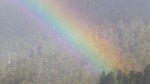
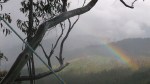
That’s all from me today. Though I’m also adding a few photos for you too. I hope you enjoy Geoff’s blog. And I’ll catch you tomorrow. Miranda.
Miranda’s Daily Blog: Day 24
 I stumbled over the answer to the question. I’ve gotten used to answering all sorts of questions about anything from the details of clause 27 in the IGA – to what I eat and where I poop! But I hadn’t been expecting this one and no one has ever really asked me before. So when the journalist said “how has the forest changed you?” I have to admit that I didn’t know how to respond. So I stumbled my way through an answer, but really what I wanted to say was give me a day to reflect on this and get back to you, it’s a big question!
So, I’ve had some time to reflect, and I want to share some thoughts with you.
The forest has changed me; there is no doubt about that. The question is hard to answer because it goes way beyond the three weeks I’ve spent in this forest. It stretches back to the first moment I stepped foot in Tasmania’s old growth forests. Or maybe it goes back even further than that…. to lying on the grass in Queens park, as a child, looking up into the tops of the trees and pretending I was in the middle of the ‘wilderness.’ Maybe it goes back even further than that?
I want to share something very personal with you and I hope you don’t mind. I didn’t know if I wanted to come up this tree. I’d been planning The Observer Tree project for a while and we were going to launch it a few months ago, because this coupe was listed for logging in October 2011. I was in Sydney having just done the banner drop on the Opera House and preparing to come back to Tassie and come up this tree. Then I got the phone call that changed everything… a good friend of mine had passed away.
It’s funny how the first thing I wanted to do was get on the plane to Tassie and come up this tree. Maybe it is my past experiences in the Floz that have shown me how much the forest can heal me. Or maybe it was the shock and denial that lead me to just want to keep busy with something, anything else. I soon realised though, that what I needed to do was go up to Brisbane to say my goodbyes and be with my community.
Two weeks later I’m back in Tassie, full swing into preparing for The Observer Tree. I’m excited but there is something weighing on my mind. I feel too scared to tell people that I don’t know if I can do it. I don’t want to let everyone down. And most of all I don’t want to let the forest down. I’m not sleeping. Instead I stay up all night watching “the secret life of plants” over and over again.
I think I feared being up here alone. With so much time to sit and think and go over and over again in my mind how things could have turned out differently… how maybe she would still be alive if…? And I didn’t want to be alone because I felt this sudden urge to spend as much time as I could with everyone important in my life. Suddenly spending time with friends seemed so important, you just never know when you’ll never get another chance. In addition, someone very important in my life, a close family member, was unwell. I spent every day worrying about them, hoping they would be ok. The Observer Tree launch date loomed closer. I called up a friend of mine who was helping with the project to break the news…. I had to go back to Brisbane. The Observer Tree was postponed, perhaps indefinitely. I felt the weight of 430,000 hectares of forest on my shoulders. How could I stand by and let this forest be torn apart? Especially now, when it was promised protection, when it is so close to being saved… could I really do nothing as the chainsaws moved in? But I had to, it was one of the hardest decisions I’ve ever made. But sometimes you just have to do what is right for yourself and your family.
As it turns out, the timing was perfect. I felt much better within a few weeks. I returned to Tasmania, packed my bags and came out to the forest. Logging began that week, and so we launched the project just in the nick of time.
You might wonder why I have told you that story and think that perhaps it doesn’t really answer the question. But as I often do, I needed to give you some back ground detail about my life in order to explain what goes on up here. Sometimes when I sit quietly watching the forest I get a feeling of sadness. I know grief takes time, I know that it comes and goes. And sometimes it pops up unexpectedly. So I let it have its place, when it needs to. But what I wanted to say is that the forest for me is a place that heals because when I am quiet and I watch the forest, listen to it, take it in… I start to understand things about life that I just didn’t really grasp in the city.
To be here in this tree that has been growing for hundreds of years before I was born and potentially ( if we give it the chance) will stay standing long after I am gone….In some ways, it makes me feel insignificant. A small spec in time on this planet. Similar to how people feel when they look up into the stars and realise how tiny they are in comparison to the universe. But the feeling of insignificance isn’t a bad one. I like the way it makes me feel humble. And honored to share a moment in time with this forest. It changes the perspective of things in my life. That is not to say that the death of a dear friend is insignificant. Because every person matters and losing a friend is difficult. But one thing the forest has taught me about is the cycle of life and death.
Here you see trees grow old, begin to rot, fall over. It’s strange how the sound of a tree falling naturally in the forest is kind of exciting, and at Camp Floz we’d all love to go and have a look, see which one has fallen and where. It is very different from the loss of a tree before it’s time, at the hands of a chainsaw. When trees fall in the forest, they may die, but they do not stop being a part of the forest. They provide shelter and homes for animals, crucial to the survival of the entire ecosystem. They become a part of the soil, to produce the next generation of trees. They continue to hold their store of carbon. They live on forever, in some ways, recycling and returning their energy into the forest for its continuance. That is why sometimes it seems almost a tiny moment in time to talk of trees that are 400 years old, when really this forest has been evolving for so many thousands of years, each fallen tree regenerating the soil to make life for the next.
Although it makes me feel humbled and insignificant, at the same time it gives me a feeling of importance. Because in the forest it is clear that everything matters. Everything has its place. From the tallest of trees to the tiniest of bugs. Every single thing is crucial to the survival of the whole, of each other. The interconnection of life is clear here.
And the thing about all these understandings I have come to see through living in the forest is; I don’t see them only in relation to “the forest” as something out there, separate from us. When I am in the forest I am a part of it as much as any of the other creatures here. And I realise that we all are, no matter where we live, a part of the earth’s ecosystem. The lessons of the forest are relevant to me because the forests’ life is my life. I am a part of the world; I will live and die like everything in this forest.
In this way, the forest has helped me to grieve and understand death. It has taught me that all things will die, but it doesn’t mean they are gone. As the trees live on after they have fallen, so too will fallen friends who have left this world behind. They will continue to bring life to this world as long as their memory remains in our hearts. All the precious moments spent together, the things they have taught us and what they have brought into our lives; they will remain behind for a long time…Keeping this community, this ecosystem, evolving and changing. Every fallen friend will be forever apart of the world, as will we when our time comes too.
This is just one way in which this forest has changed me. It doesn’t mean I don’t still feel sad sometimes, or ask “why” and “what if.” But I have found some comfort in what I have learnt from the forest. It has been a hard lesson to learn. But I am thankful to this forest for sharing it with me.
This blog is dedicated to Sophie; you will live on in my heart.
Miranda’s Daily Blog: Day 22 & 23
Spotted-tailed quolls are a rare and special sight. They are cryptic animals that, “are particularly difficult to detect during surveys” (Nelson et al 2008). That is why it was so exciting to see these ones filmed on our hidden remote sensor cameras, within a few kilometers of The Observer Tree.
On mainland Australia spotted-tail quoll populations have been devastated by land clearing and invasive species such as foxes and dingos. They are listed in the EPBC act as endangered on the mainland and vulnerable in Tasmania. They are also listed in the Tasmanian Threatened Species Protection Act as rare. As with the Tasmanian devil, there is an urgent need for more research on the impact of logging on the species. Shannon Troy, a PhD student currently undertaking such research says “In both a report to the Regional Forest Agreement, and the Spotted-tailed Quoll Draft National Recovery Plan, it has been stated that a lack of understanding of the impacts of silvicultural practices on the species is a significant knowledge gap preventing its effective conservation management.” (Troy 2011)
One thing is known for sure, logging poses a very real threat to the spotted-tail quoll. According to the Australian government’s environment website, “Land clearing: loss and fragmentation of habitat is a primary threat to this largest of Australia’s marsupial carnivores, especially areas of suitable forest with sufficient numbers of den sites and prey.” In the National Recovery Plan for spotted tail quolls, “habitat loss, modification and fragmentation and timber harvesting” are also cited as a major threat to the species” (Long and Nelson 2008).
“Habitat loss resulting from timber harvesting has been implicated in local population declines and extinctions of the endangered mainland spotted-tailed quoll.” suggests Troy (2011). In Tasmania “It is estimated that 50% of the habitat from the species ‘core distribution has been cleared, with approximately half of the remaining habitat having been subjected to logging practices in the last 20 years (Jones & Rose 1996)” (Long and Nelson 2008).
Cool temperate forest and wet sclerophyll are the primary habitat of the quoll (DPIW 2011). Essentially the spotted-tail quoll could be described as a “forest dependent species” (Long and Nelson 2008). It is exactly these types of forests that are most subject to logging in Tasmania, and the type of forest that I am sitting in right now.
“At the stand scale, clearance of mature forest is hypothesised to result in a loss of structural diversity, including a reduced abundance of hollow logs and tree hollows used as den sites by spotted-tailed quolls and their prey, and lowered prey population densities. At the landscape scale, fragmentation of formerly contiguous habitat may result in population isolation and subsequent population decline.” (Troy 2011)
Basically spotted-tail quolls need old growth forests. They rely on hollow logs and hollow tree roots for maternal den sites” (Long and Nelson 2008). Hence their abundance will be influenced by forestry practices, with flow-on effects to resident quoll populations” (Belcher and Darrant 2006, Glen and Dickman 2006a, 2006b cited in Nelson et al 2010). In addition to the need for large patches of forest with suitable dens, they also require a suitable amount of prey (Long and Nelson 2008) medium-sized mammalian prey (Belcher 2000; Belcher & Arrant 2006b; Glen & Dickman 2006a, b).(Long and Nelson 2008). Like the quoll itself, much of their prey also relies on tree hollow for shelter and breeding, “therefore forestry practises can severely impact on prey availability” (Gibbons & Lindenmayer 2002 cited in Long and Nelson 2008).
Hollow trees are a key feature of old forest. The Flora and Fauna Guarantee Act in Victoria has recognised the destruction of hollows as a “threatening process.” It states that the minimum age at which sizable hollows begin to form depends on the tree species; ages of 120 years and up to 300-400 years have been cited.” Once old growth areas are logged in Tasmania they become a managed forest that is felled on rotations of around 80 years – not enough time to provide these crucial tree hollowsLiterature on the relationship between spotted-tail quolls and their habitat also showed that burning after felling was problematic and raised particular concerns about the impact of forestry operations occurring around breeding season (Andrew 2005, Watt 1993 cited in Long and Nelson 2008)
Dr Menna Jones from UTAS has done extensive research on devils and quolls. She states that “quolls live at low density and need a lot of space. Their conservation needs to be addressed at local, landscape and regional scales “(Jones 2011) The females are territorial, defending their home range from other females. This also limits their ability to adapt to degradation of their home ranges” (Nelson et al 2010).
The National Recovery Plan states that “given the threatened status of the Spotted-tailed Quoll, all habitats within its current distribution that are known to be occupied are considered important” (Long and Nelson 2008). As with the Tasmanian devil, it is critical that all possible steps are taken to ensure the survival of this species. With such clear evidence that this species relies on the very trees that are being cut down through industrial scale logging, it is questionable how such practices can be allowed to continue. The loss of either the Tasmanian devil or the spotted-tail quoll would be not only a tragedy for the species itself, but it would also have dramatic impacts on the populations of other predator and prey species, “because as carnivores, they are essential for ecosystem function” (Jones 2011).
It is time to protect the large tracts of intact old forests that are so vital to the survival of this beautiful and important animal.
References cited:
Shannon Troy: http://www.crcforestry.com.au/view/index.aspx?id=47683
Dr Menna Jones: http://www.zoo.utas.edu.au/hons/mj_proj.htm
Nelson, J., Scroggie, M., Woodford, L. and Robley, A. (2008). Assessing the distribution and status of the Spot-tailed Quoll population of the Otway Ranges, South West Victoria. Unpublished report to the Department of the Environment, Water, Heritage and the Arts. Arthur Rylah Institute for Environmental Research, Department of Sustainability and Environment, Heidelberg, Victoria.
DPIW: http://www.dpiw.tas.gov.au/inter.nsf/webpages/bhan-5373rd?open
Australian government environment department: http://www.environment.gov.au/biodiversity/threatened/publications/pubs/tiger-spotted-quoll.pdf)
Long, K. and Nelson, J. (2008) National Recovery Plan for the Spotted-tailed Quoll Dasyurus maculatus. Department of Sustainability and Environment, Melbourne.
Miranda’s Daily Blog: Day 20 & 21
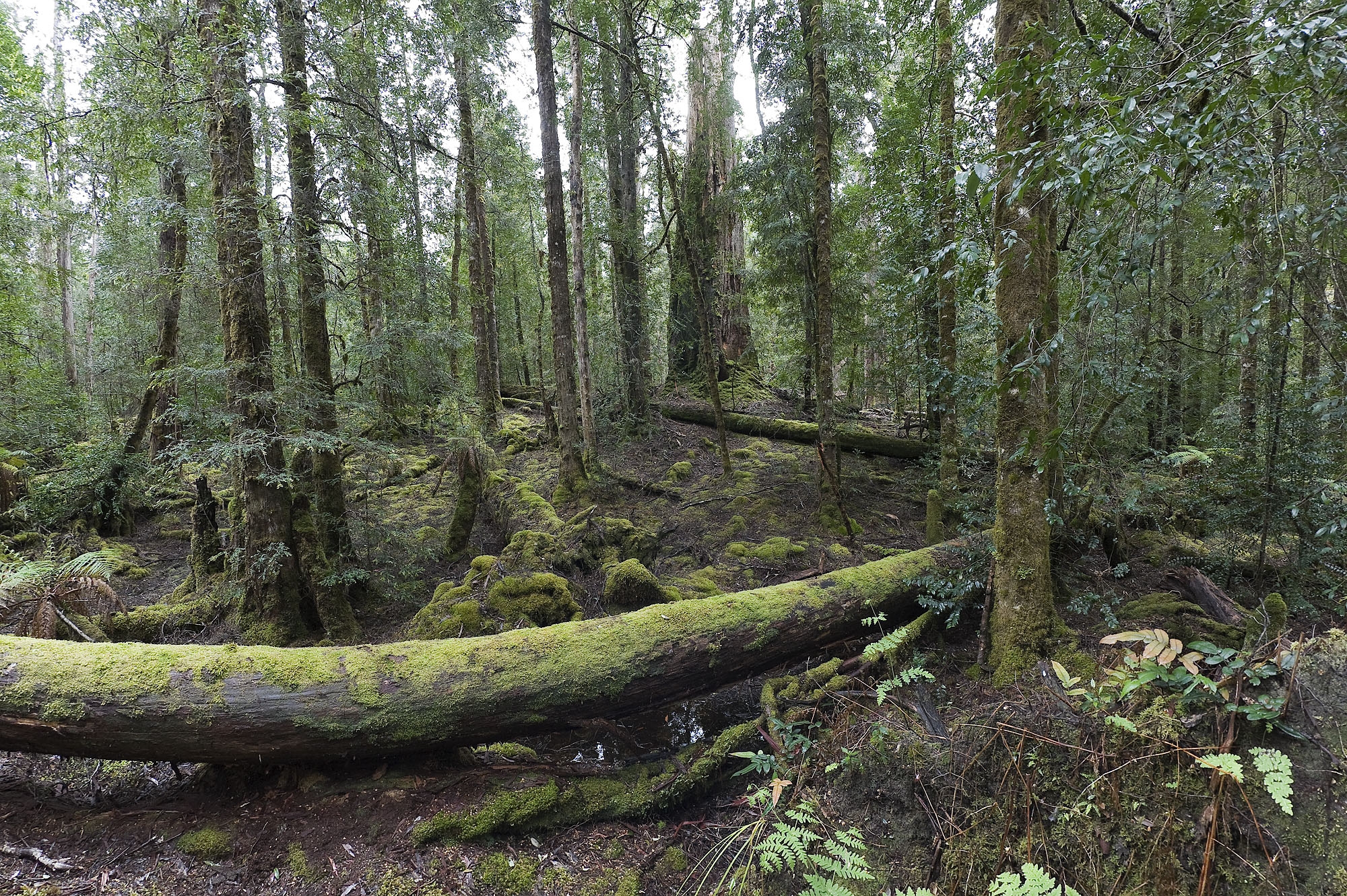
 I want to tell you a story about this forest….
I first visited this particular patch of Tasmania’s south west almost four years ago. A delegation was coming to Tasmania from the World Heritage Committee, International Union for the Conservation of Nature and ICOMOS. In preparation Still Wild Still Threatened did comprehensive surveys of 40 areas of forest scheduled for logging, all that were within 2 km of the boundary of the current Tasmanian Wilderness Wold Heritage Area (TWWHA). It was a hectic mission, but an inspiring one. Every day we would leave from Camp Floz in teams of four, off to different valleys – the Styx, Wedge, Counsel, and Tyenna.
I knew this place was special as soon as I saw it. I didn’t need the data on the survey sheet to prove it (though it did anyway).
It was a slightly overcast rainy day ( you know the ones typical of Tasmania’s wet forest) and we traipsed through the bush trying to keep our notebooks dry as we recorded the details of the spectacular world we’d found ourselves in. Gullies bursting to the brim with ferns, growing tall as trees, their rough bark scattered with epiphytes; filmy, kangaroo and finger ferns growing like a vertical garden up their trunks. Waterways spread through the valley everywhere, trickling their way down from Mount Mueller, which loomed above us. Up on the ridges we were met with vast tall eucalypts rising up from the ground 60-70 meters tall. These ancient trees are some of the most carbon dense in the world. Research done by Still Wild Still Threatened to radio-carbon date trees of a similar size in the nearby Styx Valley found that the trees had been between 400-600 years old when they were taken down by a chainsaw.
As we walked I could see a clearing in the distance. I looked at the map, but it didn’t correspond with any roads or clearings. I knew something wasn’t right. As we pushed on I could see the clearing was a road. Stepping out of the lush dense forest onto a brand new gravel road felt devastating. The road itself was like a clear fell, zigzagging its way up the hill, taking out most of the forest on the entire slope as it went.
It was then that it hit me – how precariously this forest was teetering on the edge of survival, so close to being lost forever. With the road complete and the Forest Practises Plan cleared, logging could begin at any time. We walked back through the bush a little quieter than before. Reflecting on what this meant for these ancient trees that stood silently around us, waiting defenceless for the moment when the evolution of an ecosystem would be brought to an abrupt and ruthless end.
The survey project for the World Heritage Committee delegation was a time of great hope for me. Recording meticulously the flora, fauna and the other world heritage values would surely provide evidence to the committee to show how important these forests were. I really believed that those coupes might never be logged.
The good news is that the World Heritage Committee and the IUCN did see the importance of the forests. In 2008 both these organisations voted unanimously in favour of the need for the TWWHA border to be extended to take in these forests.
You see, the thing about the TWWHA is that although it is quiet extensive, it is not necessarily representative of all vegetation types. The protected area covers mountain tops and alpine areas. These are significant ecosystems, but they were not under threat because they have no use to the logging industry. Looking at the map of the TWWHA you will notice the way the boundary follows the contours of the landscape. This is because where the mountain tops give way to the forest at the tree line, the border stops. The areas of tall trees, the areas most desired by the logging companies are excluded from protected zone. This is why the World Heritage Committee stated in 2008 “only 29% of tall eucalypt forest is included within the property (TWWHA) it has also been suggested that the values outside the property are different and complementary to those of the tall eucalypt forest included in the property. Areas of high potential value as World Heritage have consistently been identified, including tall eucalypt forests in the Styx Valley and the Upper Florentine” (WHC-08/32.COM/7B).
With the IUCN and World Heritage Committee making remmendations to the government for the boundary to be extended, it felt like there was a chance to save those precious forests at the base of Mount Mueller.
In 2009 we were out surveying again. This time we were not taking note of flora and fauna, we were taking notes of log piles, machinery, stumps and burning clear-fells. Still Wild Still Threatened reported to the WHC and IUCN that of the 40 coupes surveyed the year before 18 had been seriously degraded by forestry operations. In addition another 7 coupes within 2 km of the TWWHA border that had not been on the previous logging schedule had been impacted by operations. A year had passed and the government had done nothing to act on the WHC recommendations. It was clear that the area surrounding the TWWHA was becoming increasingly fragmented as more and more logging occurred in close proximity, sometimes even coming right up to meet the boundary of the protected area, with no buffer zone. Another year passed and still no action had been taken by the government. This time we reported an additional 11 coupes had been lost to logging operations and two more had roading complete.
That was two years ago now. We didn’t do an update report last year. I guess it just didn’t seem like the government would ever take notice of the World Heritage Committee’s recommendations. It seemed like the intact forest stretching out from the TWWHA would become fragmented and disjointed, separated by clear-fells and if we ever got the government to listen I feared it would be too late.
These forests at the base of Mount Mueller have always had a special place in my heart. I’ll never forget the giant tree we discovered in TN49A – 18.7 meters girth around the base. Part way up the trunk split, so that it almost looked like two trees growing closely together. Its nickname became “forked tongue.” It is one of my favourite trees. In TN48A we measured a tree 16.5 meters in girth. Neither of these trees made it into the “giant tree” list. To receive protection as a giant a tree must measure over 85 meters in height. This can be a bit of a disadvantage for the very old trees. Like people they tend to shrink a little with age. Their crowns begin to die and then drop off, shortening the tree. The dead crowns of old trees can be seen from a distance. As you look out across valleys of old growth you can see their pale grey sticks contrasting against the green forest. As for trees that are exceptionally fat, like ‘forked tongue” they get no special protection, unless they meet the criteria based on volume (280 cubic meters), which can be difficult to achieve without the height too.
Walking up Mount Mueller is a special experience, and if you’re ever out this way, you should give it a go. The track goes through a proposed logging coupe, so hopefully it is still intact when you get the chance to do the walk. Up on the mountain is a glacial lake called “Fossil Lake” it is surrounded by pandanii and looks out across the Styx and Tyenna valleys. I think there is something special about the fact that the mountain is also the beginning of three spectacular rivers that run through three of the most spectacular forests – the Florentine, Weld and Styx.
(Click here for a bushwalking website that details the walk)
I remember a friend of mine whom I’d spent many walks with in these forests had to leave Tassie for a while. “Keep an eye on those Mueller coupes while I’m gone” he said. And I did. I have spent many nights in the rain and sometime snow, checking up on these forests. That feeling of driving up the road and your heart stopping for just a second as you round the corner…. Waiting to see what you will find, will the forest be there or will it be replaced by machines working their way greedily through the trees?
One night about two years ago now I had a night mare about this coupe I’m sitting in now. I dreamt that logging started and I tried to tell people but no one would listen. I wanted to stop the destruction but no one had time to help. It’s funny how I still remember that dream and the disheartening feeling it left me with when I woke up. But here I am today, sitting in this coupe, and lots of people are listening. Yesterday I checked my emails discovering all these messages from people in France who had read about The Observer Tree through a French website. Today I had a visit from local residents of the Derwent Valley who brought me fresh fruit and vegetables. People are listening all the way from New Norfolk to Paris! The government may not have listened to the WHC or the IUCN, but we are going to make sure that they start listening to us. Because the people of Australia and the world are recognising how unique and valuable these forests are and we are not going to let them be taken away forever simply to line the pockets of companies like Ta Ann.
Today marks three weeks since I started my constant vigil at the top of this tree. The word is starting to spread around the world, so keep up the good work in sharing this blog as much as you can.
Talk to you tomorrow, Miranda.
Click on links below to view Still Wild Still Threatened’s reports to the IUCN and WHC
2008
2009
2010
Miranda’s Daily Blog: Day 19
What a way to see the New Year in! I woke this morning to honey eaters hoping about in the branches above me, the sound of fan-tailed cuckoo’s reverberating through the forest, a pair of swallow-tail butterflies flittering in the morning sunlight. And I thought: this has got to be a good year!
Last night was a time of contemplation, thinking over what this past year has been like and my hopes for the new one. Its funny how at first I thought …hmmm, not much happened this year. But when I started thinking about it and remember everything that’s gone on, I thought – wow, what a big year it’s been!
This time last year, I saw the New Year in at Falls Festival. It was a nice respite from the process of scouting logging coupes. Since attending a meeting with Forestry Tasmania in December 2010 Still Wild Still Threatened were comprehensively monitoring all the logging operations in our district, the Derwent. It had been a mixed bag of emotions, visiting beautiful forests and devastating clear-fells. But it felt positive, because FT was apparently going to be working on a rescheduling process to place 572,000 hectares under a moratorium by March 15th 2011.
So there I was at Falls, amongst thousands of people, when only days before I’d been in the middle of a forest while it snowed (yes, snow in December, pretty exciting!). And soon after Falls, I was off for more scouting. Now, I guess, it feels like a waste of time. Forestry rescheduled none of those coupes, no moratorium was put in place and the majority of intact forest areas we visited have been felled since then.
It was March 15th, when the moratorium deadline was not met, that I could no longer deny the reality – the “forest peace talks” just weren’t bringing peace for the forests, as logging continued. And so I admitted that sad fact not only to myself, but to everyone watching the nightly news… as I stood there at one of my first press conferences, a fledgling media spokesperson, shy and trembling with nerves. I don’t know how I found myself in such a position. Being so shy I never would have imagined having the confidence to stand in front of so many cameras and answer tricking questions about whether we felt betrayed and so forth. I wondered if the people watching at home could tell how much I was shaking! I have enjoyed the journey of slowly developing confidence through being media spokesperson for Still Wild Still Threatened this year. I think that the thing that has helped me along the way is my passion for the forest and my true conviction in what I am saying. I just hope that this comes through despite the nerves! Even to sit here and share so much of myself through these blogs is something I wouldn’t have imagined doing a while ago. So, I guess that is something that 2011 has brought me and I’m grateful for the opportunity to share my passion and knowledge about the forest with other people. And to be dragged, somewhat reluctantly at first, out of my shyness! Anything for the forests, I guess!
One of my favorite moments of 2011 was when we brought forest blockading to the place where it really matters, to the place where decisions are being made every day about which forest will be lost and when…. the offices of Forestry Tasmania, Hobart. There was something satisfying about the managing director and other top officials turning up to work and being unable to enter the office. Why? Because every day they are in that building handing down death sentences to places they have never seen, animals they have never meet, trees they have never climbed, and rivers they have never swum in. They are drawing lines on maps and writing out statistics – and to them it might be just another line, just another number. Meanwhile, we are out in the forest watching the destruction every day, trying our best to halt it or at least slow it down. And the heads of Forestry don’t have to deal with us. They can sit in their office, far removed from the front lines. So that is why I think the action we did that day is significant. It is within the walls of that building that devastation is born and it is important that not only we remember it, but we remind them of that sometimes too!
My other favorite moment of 2011: climbing the Sydney Opera House to drop a banner calling on Harvey Norman to stop sourcing wood from our precious native forests, as part of a global day of action. I haven’t really mentioned Harvey Norman in my blog so far. But I will be getting to them a little latter. Native forest from Tasmania and other areas across Australia is felled, shipped to China to be made into furniture, shipped back and sold in Harvey Norman stores. And often the customers don’t even know that the bed or table they buy was once a 400 year old giant eucalypt in a pristine forest ecosystem, much like the one I’m sitting in right now. I’ll talk more about Harvey at a later date. But for now, I’ll say the banner drop on the opera house was amazing because it generate loads of media and really helped to bring the message to Harvey Norman that forest destruction will not be tolerated.
2011 brought some hard times too. Both as a forest campaigner and personally. I have already spoken in my blog about the difficulty of being involved in the forest peace process, feeling hopeful and then having those hopes destroyed when the government failed to act on their promise. 2011 was a time of loss, losing a lot of precious forest that I came to know through the surveying. I also had some personal losses in my life. I guess this blog is meant to be about the forest, but it is hard not to make it personal, because for me the forest campaign is interconnected with my whole life. So I will tell you this. For all the tricky times that came along with 2011, I have learnt a lot. I have learnt the value of family and friends most of all. I have come to realize how precious the people in my life are, and never take them for granted. I have learnt the importance of telling the people how much you care about them. And I have also learnt that no matter how much I care about the forest, it is just as important to spend time with your friends, family and people you love, while you can. This has been a hard lesson to learn. Taking a bit of time away from forest campaigning to be with friends and family gave me a chance to be close to those I love. And now, strangely, this project has also brought me closer to people. It has brought me closer to my family, because through reading my blogs they have come to know me better. It has especially brought me closer to my sister who has become my number one fan, promoting the blog and calling me each day to talk about my life up in the tree. I’m grateful for this chance to be closer to people, despite being separated not only by distance, but by height too!
And so, today is the first day of a new year. I have many hopes for 2012 … I guess I don’t really have to tell you what they are, because I say it every day! But I really hope this forest will be protected.
I’m not the only one with high hopes for 2012. Julia Gillard in her new year’s speech said 2012 is “a time for new hope and new beginnings” and that “better days lie ahead.” Let’s hope she means what she says and that her new year’s resolution this year might be to honor those promises she made to the people of Australia in 2011.
I haven’t lost hope, despite the broken promises of Julia. I do believe forest protection could be possible in Tasmania this year. But I don’t think it is going to happen easily, at least not without a lot of pressure from the people of Australia. And so I guess that is where my sense of hope lies now -not in Julia, but in you. Because I hope everyone who reads these blogs will feel inspired to take action. Whether its writing a letter to Julia, visiting your local Harvey Norman store to ask them to stop selling native forest products, sitting in a tree, displaying a banner, organizing a community forum… I guess the list is endless and I’m sure you all have your own ideas of how to help save these forests. I hope that together we can make 2012 go down in history as the year that Australia’s native forests received the protection they so desperately need.
Yep, I think it’s going to be a good year indeed!
Even Julia says it’s going to be, I don’t think she would lie? Would She??
Miranda’s Daily Blog: Day 17 & 18
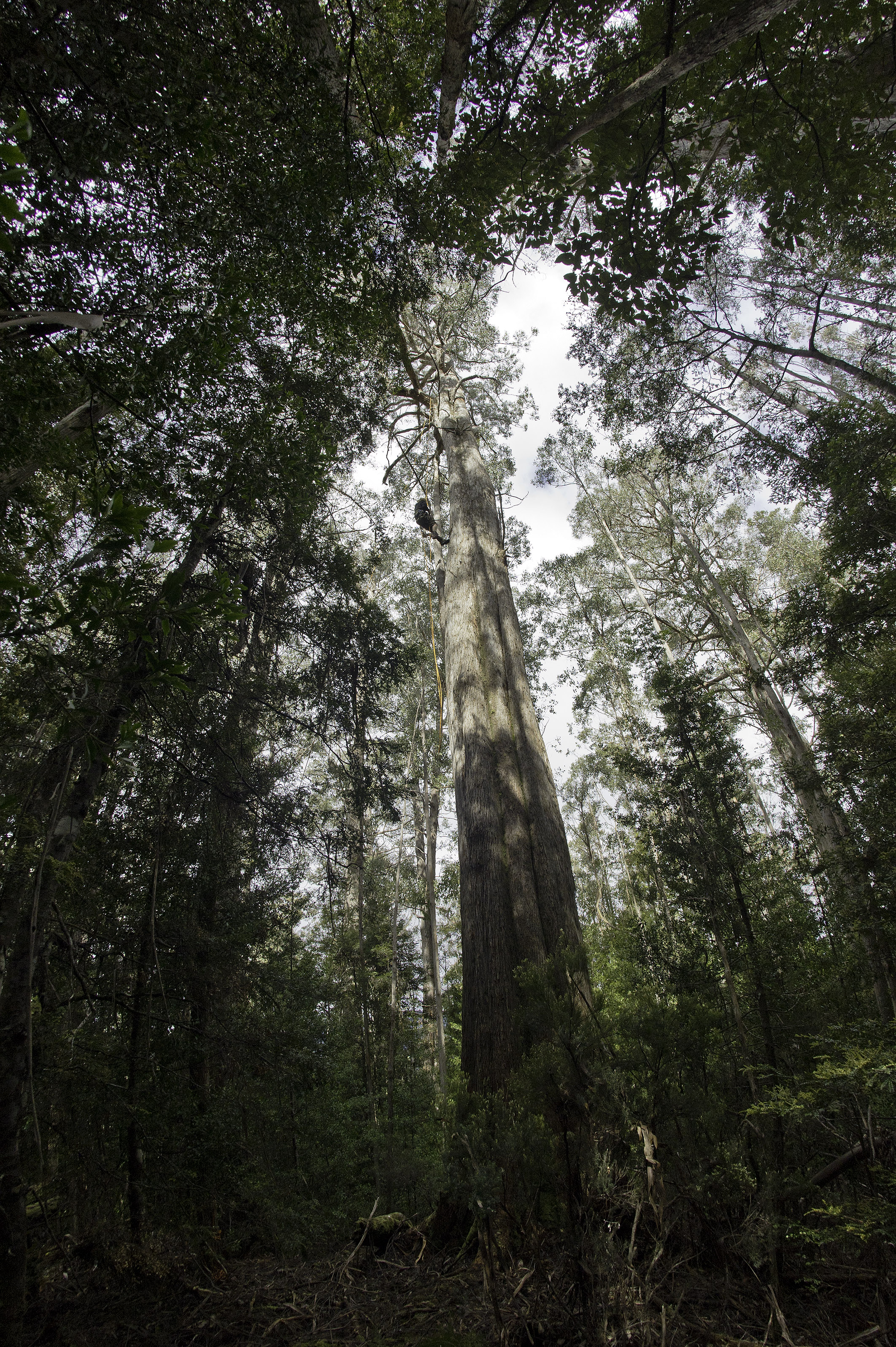
Please join me on a grand tour of my house up here in the tree tops of Mount Mueller!
For some, a virtual tour is just not enough and they had to come take a peek for themselves. Here’s the police helicopter coming for a bit of a look yesterday morning.
Hope you enjoyed the view into my life up here in the tree sit.I have done a combined day 17 and 18 blog for you today, because otherwise I’m starting to get a day behind! I wanted to give you something not too heavy for this celebratory New Year’s Eve time. That’s why I made you a little video blog about my home. But while I was doing this and contemplating the clear-fells in the distance… It’s got me reflecting on what 2011 has been like for the forests. I starting thinking about how that very clearfell I can see from here was once an amazing old growth forest, which should have been protected through the Statement Of Principles process. A moratorium should have been in place before the negotiations were allowed to continue. What is the point of talking for two years about protecting the forest if you are destroying it every day during that time? So, I thought I’d share with you a little video from a tour of that area of clearfells down there, in March this year. It’s a little sad, so maybe if you are in a happy New Year’s vibe you can save this one for a day when you need a reminder about why it is we need to keep up this fight for the forests.
Hope you all have a great night tonight. I will be enjoying seeing the new year in from this spectacular viewpoint. It will be nice to welcome 2012 from the top of this tree in this beautiful forest. Good bye to 2011: the official “international year of the forests”. And welcome to a new year that will hopefully become the real international year of the forests- the year in which these forests and forests across the world get the protection they so dearly need.
Talk to you again in 2012!
Happy New Year!
Miranda
Miranda’s Daily Blog: Day 16
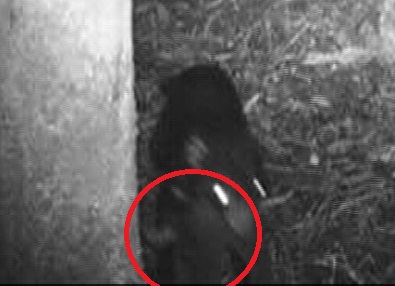
It’s late at night when I get the phone call from Lily Leahy. She is as excited as I am about the 2 seconds of footage and what it shows. She too has watched it over and over again, slowing it down, stopping it at the crucial moment. Taking another look. Who could have known a small dead animal hanging there limply would generate so much excitement between two conservationists. But it is the implications of the dead animal being carried in the mouth of this devil that has got us talking tonight. Why? Because never before have we seen such a thing on our cameras. Devils don’t need to carry their food around, you see. They can eat up to 40% of their body weight in 30 minutes – quiet an impressive feat! So there is no need for storing food unless….. Of course…. you have babies in the den that can’t go and collect it themselves! It looks like what we have here in Julia’s Forest is a mother devil taking food to her young in the den.
The excitement turns to worry, as I flick through footage and dates and data in a state close to panic. What was the date of on that footage? December 12th 2011. No, oh no. What camera was this seen on? 1.1? Yes, defiantly 1.1- there is no denying the reality. Six hours later, machines would be moving in as logging begins within 100 meters of this location. I hope she made it back to the den. I hope the babies are safe.
Next I call Colette Harmsen, a vetinarian whose special interest is the care of Tasmanian wildlife who has been working closely with devils for the past 5 years. She confirms the hypothesis Lily and I have discussed. “I definitely wouldn’t expect a devil to carry food anywhere except to take it to its young” she said. “At this time of year the babies are getting too big to be carried in the pouch or on their mother’s back, but they aren’t yet old enough to be fully independent. They would be waiting at home in the den while Mum goes scavenging for food for them. ”
“If devils were denning close to where logging is happening, this would cause major disturbance, including from noise and vibrations from machinery. Devils are particularly sensitive to unfamiliar noises, as their hearing is exceptional, so any loud noises are likely to disturb them” Colette said.
There is a real risk that young devils could die within dens. From her experience working with devils Colette explains that the typical behavior of a wild devil when it is threatened is to freeze, hide and stay very still almost as if immobilised with fear, rather than to run away. “We get a lot of calls from people who have a devil trapped in their shed or garage and they think that it is really sick because it isn’t moving. But usually it is just scared and that is how they tend to react.”
The real problem seems to be a lack of research. From talking to Colette and others who work with devils, there just hasn’t been enough research done to establish the full impact that forestry operations would have on den sites. For the industry to continue to decimate potential devil dens without even knowing fully the impact this will have is inconceivable, when considering the very real threat of extinction that may be facing the species.
“There is no doubt that there would be devil babies buried when machines move into new areas. Because there are currently no laws or proscriptions requiring Forestry to meticulously check areas for devil dens” said Colette.
We talked about what might happen to the devil seen on our camera, and to her babies. Even if she realised something wasn’t right and managed to get the babies out of the den it may be very difficult for them to survive. Relocating them at that age is problematic because they are too big for her to carry. And if they are in a state of fear due to un-known noise disturbances they may react unpredictably. There is also the very real problem of finding a new home. Devils seem to be picky when it comes to finding the right den, because there are specific conditions that need to be meet in order to keep the babies safe. For example an ideal den has small side-chambers for the pups to hide in to keep them out of reach of danger. Devils rely on old wombat burrows, caves, or other ready-made homes and these can be in short supply, and can be especially hard to find in areas where borrowable soil is limited. “Unless the mother already knows of another possible denning site, it would be very difficult for her to relocate the babies quickly” Colette said.
According to David Owen and David Pemperton: “Habitat interference affects animals by altering the refuges where they breed, raise young and rest. For the devil this could be critical. Maternity dens are carefully selected to provide a safe haven from the elements and from scavengers. Young devils get cold easily and need the warmth from their nests and the sun. Favored dens are strongly protected and may have existed for centuries. Destroying them through, for example, land clearance, disrupts population stability” (Owen and Pemberton 2005:76).
Due to the impact of DFTD (devil facial tumor disease) the death of one healthy devil can have a major impact on population stability in an area. Because so many devils are dying at a young age, sometimes not even old enough to breed successfully, the birth of new devil pups is significant. “The loss of any healthy individual devil is a significant loss for the genetics of the population in that area” said Colette. “Devil babies represent the potential new healthy generations. DFTD is having a drastic impact on devil populations and we need to be doing all we can to protect this species. More research is urgently needed as to the impact of logging and other disturbances.”
Despite these concerns, Forestry Tasmania is taking no action to ensure the safe survival of the devil seen here on our camera, or her babies. We have not seen any devils on film since the logging started and we can only hope that she has managed to relocate them to safety. It is hard to tell from the brief glimpse of her on this footage if the mother devil is Davina or a different devil, though it seems like it could be a different one. We will keep putting out the remote sensor cameras and see if we see her again. In the meantime, I guess it’s time to really put the pressure on the government, Forestry Tasmania and Ta Ann to stop the destruction of devil habitat before Tasmania loses another iconic species forever.
Reference:
Owen D and Pemberton D (2005) Tasmanian Devil: A unique and threatened animal. Allen and Unwin Publishing: Melbourne.
Miranda’s Daily Blog: Day 15
Following on from my Day 14 Blog, I made this little film for you, to show the process of checking up and monitoring the fauna cameras. My apologies for the late post, I had some power problems last night, but I’ve got the computer going again this morning. Make sure you check the website again this evening, because I am working on a very exciting blog for today… about something very interesting captured on film from one of our fauna cameras! So stay tuned!
Till Then, hope you enjoy the film.
Miranda
Miranda’s Daily Blog: Day 14
“In May 2009, the Federal Government uplisted the Tasmanian devil to the Endangered category under the Commonwealth’s Environment Protection and Biodiversity Conservation Act 1999.
The Tasmanian devil’s status was formally upgraded to Endangered under Tasmania’s Threatened Species Protection Act 1995, in May 2008.
In late 2008, the Tasmanian devil was also uplisted to Endangered on the Red List of the International Union for the Conservation of Nature and Natural Resources (IUCN) – widely considered the most authoritative system for classifying species in terms of their risk of extinction.
Populations in which DFTD has been observed for several years have declined by up to 95% (approximate, due to low sample size in recent years), with no evidence to date of either of the decline stopping or the prevalence of the disease decreasing.
The Tasmanian devil is now wholly protected.”
(Save the Tasmanian Devil Program: 2011)
On the night of December 12th 2011 a Tasmanian devil was filmed in this forest. The next day logging began within 100 meters from the very place where that devil was seen. Is this what it means to be “wholly protected?”
The question is: How can the State and Federal governments allow logging of habitat areas for Tasmania’s most iconic species, which is now under serious threat and is supposedly “wholly protected?” Don’t you think it’s a bit strange how we have all this environmental legislation but Forestry doesn’t have to worry themselves about it? These amazing forests that provide habitat for endangered and threatened species can be logged with no regard for any regulations of the EPBC Act, because the Regional Forest Agreement exempts forestry operations from such legislation.
I spent the afternoon today sorting through footage captured on our remote sensor cameras. It is always one of my favourite moments… plugging the camera into the computer, waiting in anticipation to see what animals we have on film! I sifted through all the devil footage we have captured in this coupe so far to identify the devils. Almost all the footage is of the one devil. I thought since we are getting to know this little devil so well now, that it deserved a name. I have named it Davina the Devil. Named after my sister (whose middle name is Davina) because she has been such an amazing support and inspiration for me throughout this project. Davina the Devil has been captured on film earlier this year when we first began surveying this forest, right below me at the base of this tree
Then again Davina was seen in another location in this coupe in September. December 12, the night before logging started is the last time Davina was seen. The logging is within 100 meters of that location. I hope that sometime soon we will get more footage of Davina so that we know nothing terrible has happened.
Check out the footage of Davina and the other animals we have filmed on the “Fauna TV” page of this website. I’ll keep updating this page as more footage comes in. People will be moving and checking the cameras every few weeks, and sending the footage up to me in the tree so I can upload it for you to see.
It is with mixed emotions that I watch this footage. It brings so much joy to see these animals that live in these forests. Particularly the devils because they are quiet shy, so it is rare to see them. The remote sensor cameras give us a chance to get a glimpse into their world without imposing on them. However, it also saddens me to see them; going about their business, not knowing what is to become of their forest over the next few months. It is an international disgrace that Tasmania continues to allow the destruction of habitat of endangered species. It makes a complete mockery of any endangered species legislation if listed species receive no protection from the loss of habitat. This is why it is even more critical that these forests receive protection. Julia’s’ broken promise is not only a threat to the giant eucalypts; it is a threat to the survival of the precious wildlife that call these forests home. Please take action today to help protect Davina the Devil.


 T h e O b s e r v e r T r e e