Category Archives: Videos

Miranda’s Daily Blog: Day 78
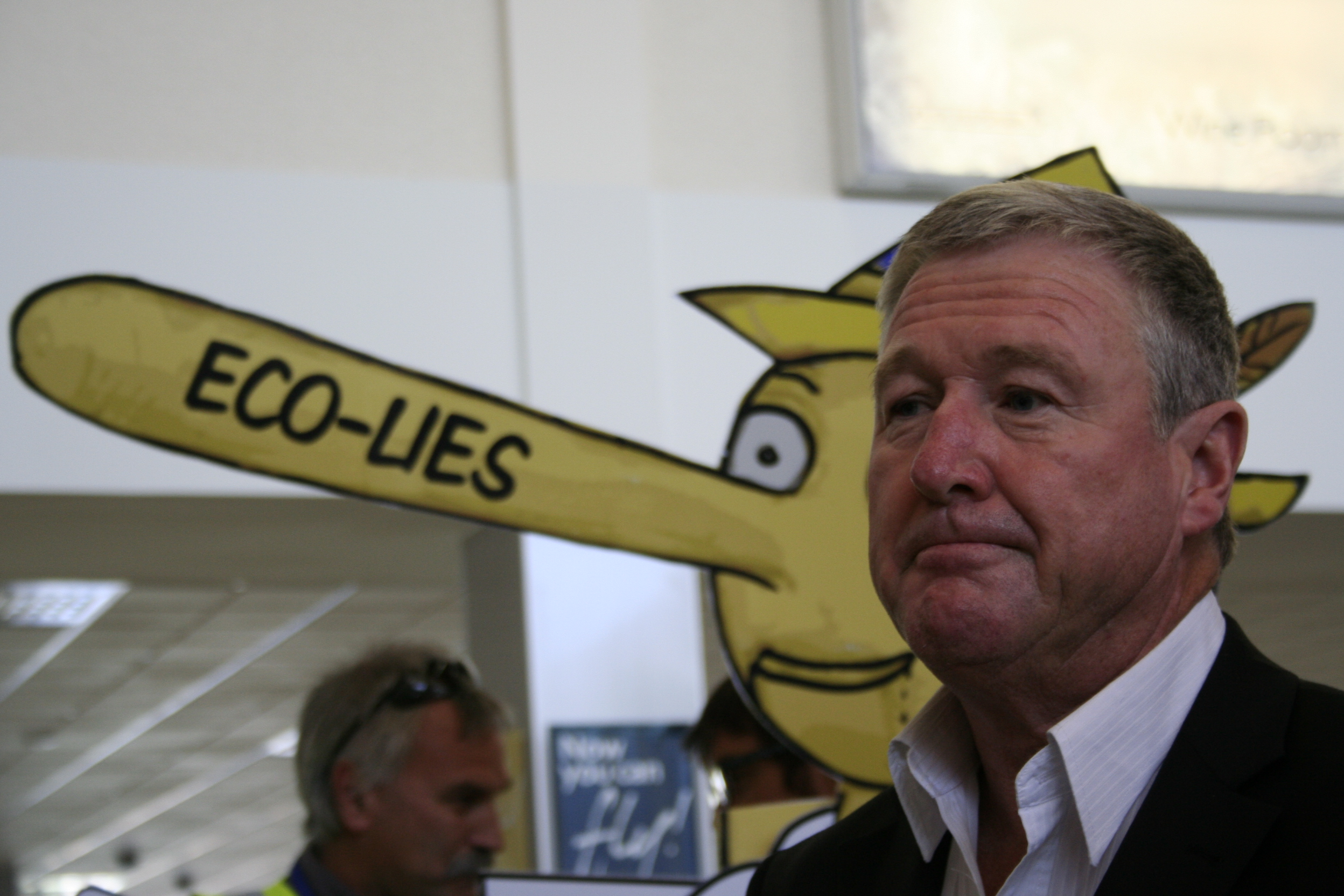 Pinocchio has come to Tasmania to sniff out the lies of the forest industry!! And his nose lead him right to the airport yesterday, to meet Deputy Premier Bryan Green. Bryan was returning from a trip to Japan, where he met with Ta Ann and with their corporate customers. This could have been a oportunity for him to work with Ta Ann to help get them out of native forest destruction. But has Bryan Green simply continued the greenwashing and lies that Ta Ann have been spreading across Japan?
Pinocchio was not fooled by the greenwashing though. In the last few days he as been on a tour of Tasmania, seeing for himself the destruction that is occurring. Pinocchio visited to devastating clearfells and logging operations, where the wood from high conservation value forests is destined for the veneer mills of Ta Ann. Armed with these cold hard facts, Pinocchio stood beside Bryan Green at the Launceston airport and called Ta Ann for what they are: eco-liars.
Thanks to The Last Stand, Huon Valley Environment Center and Code Green for standing with Pinocchio in his efforts to expose the lies! You can join him too…
 Please help Pinocchio to dob in the lies of Ta Ann! Click HERE to take part in the cyber action!
Check out this slide show of Pinocchio’s tour.
Pinocchio’s welcome home for Bryan Green made it to the top story on ABC news. Take a look….
Tasmanian news coverage Feb 15th
Check out last night’s news coverage on the ABC Tasmania. Some great footage of some of the global 24 hours of action including the amazing banner drop on the Black Mountain Tower in Canberra and the Hobart community action at Parliament Lawns. And despite a few technical hiccups along the way – we managed a successful press conference with me beamed in live from the tree tops!
ABC:
WIN:
Video for Projecting during Global 24 Hours of Action
For those crew projecting images as part of your global action: click on the vimeo link and you can download the footage/ slideshow. Contact us if you have any dramas. And happy projecting!
Miranda’s Daily Blog: Day 55
Thought you might enjoy this little film I made recently, about a month before I came up this tree. It’s called Harvey Norman and the Homeless Animals. The first part was filmed very close to here, in fact. In the Styx Valley. A logging coupe known as SX09B. The film stars my wonderful mum (though she may be difficult to recognise, being dressed up as a native animal). It also features footage of animals seen on our hidden cameras in this coupe, and the other Tyenna coupes near-by. Hope you enjoy!
I’m writing this as I listen to the sound of rain falling softly on the tarp and the wind rustling leaves outside. It feels so calm compared to last night…another wild and windy tree top adventure! I climbed to the top of my tree – (admittedly not too difficult as it is only a few meters away from the platform). And sat in one of the top most branches, watching the wind rip through the trees around me. Feeling my tree sway and shake, the branches bend, the leaves pushed and pulled, straining as though trying to break free from their stems. All around me the forest was in motion. I could see the trees dancing on the ridges opposite me. They are appear somehow synchronised and haphazard at the same time, as they sway to the beat of the wind. It was all fun and games, until the rain came. It pelted down with no mercy. And the wind whipped at my tarp, ripping it from its eye-lets. Water was gushing into my house, near my bed. As I hurriedly repaired that corner, I turned around to see puddles forming beneath constantly dripping holes in the tarp. A quick and inventive patch up of these with some tape and garbage bags seemed to do the trick, for a moment at least. While I was doing this, the other corner suddenly broke free and the wind drove the rain into my storage area. I had to quickly finish the garbage bag patch up and move on to the new problem. I just hoped that this would be the last one. The wind beat at the tarp so relentlessly that the movement shook lose the tape. Buckets and containers under the leaks was the best I could do at that stage. The calmness of today gave me the reprieve I needed to get those holes and eye-lets fixed. And now it feels comforting and cosy beneath the tarp while the rain falls outside. My fairy lights given to me at christmas time, providing a multicoloured glow of light by which to type.
Hope you’re all as cosy and comfy as me, tonight. Enjoy the movie and I’ll catch you tomorrow.
Miranda
Miranda’s Daily Blog: Day 29
Day 29 is a photo blog. This is a beautiful compilation of photos I took of the sun rising up over the snow-capped mountains and the mist floating up out of the valley through the trees. I hope you enjoy!

Miranda’s Daily Blog: Day 25
Thanks to long-time Tasmanian forest campaigner Geoff Law for the wonderful guest blog “The tale of two forests.” To give you all a chance to read this great piece of writing, I’m going to keep my entry short and sweet today.
The most amazing part of my day was seeing a Wedge Tail Eagle souring above me. The thing about wedgies is they are mostly silent. While other birds you hear coming from a long way. It is by chance that I turn my eyes towards it… something compelled me to turn around and look into the silent sky. And then I see it, gracefully moving with seemingly no effort, high above the valley. With an estimated only 60-80 breeding pairs left in Tasmania, they are a special sight. The experience always leaves me with a feeling that I have just been a part of something very amazing. It circled above the valley for a few moments. Just long enough for me to fumble around with the camera and get some footage. Then off it went, up over the ridge and towards Mount Mueller. I felt so excited; I wanted to tell somebody, everybody…. lucky for me I have twitter up here! Here is the footage I managed to catch…
That’s all from me today. Though I’m also adding a few photos for you too. I hope you enjoy Geoff’s blog. And I’ll catch you tomorrow. Miranda.
Miranda’s Daily Blog: Day 22 & 23
Spotted-tailed quolls are a rare and special sight. They are cryptic animals that, “are particularly difficult to detect during surveys” (Nelson et al 2008). That is why it was so exciting to see these ones filmed on our hidden remote sensor cameras, within a few kilometers of The Observer Tree.
On mainland Australia spotted-tail quoll populations have been devastated by land clearing and invasive species such as foxes and dingos. They are listed in the EPBC act as endangered on the mainland and vulnerable in Tasmania. They are also listed in the Tasmanian Threatened Species Protection Act as rare. As with the Tasmanian devil, there is an urgent need for more research on the impact of logging on the species. Shannon Troy, a PhD student currently undertaking such research says “In both a report to the Regional Forest Agreement, and the Spotted-tailed Quoll Draft National Recovery Plan, it has been stated that a lack of understanding of the impacts of silvicultural practices on the species is a significant knowledge gap preventing its effective conservation management.” (Troy 2011)
One thing is known for sure, logging poses a very real threat to the spotted-tail quoll. According to the Australian government’s environment website, “Land clearing: loss and fragmentation of habitat is a primary threat to this largest of Australia’s marsupial carnivores, especially areas of suitable forest with sufficient numbers of den sites and prey.” In the National Recovery Plan for spotted tail quolls, “habitat loss, modification and fragmentation and timber harvesting” are also cited as a major threat to the species” (Long and Nelson 2008).
“Habitat loss resulting from timber harvesting has been implicated in local population declines and extinctions of the endangered mainland spotted-tailed quoll.” suggests Troy (2011). In Tasmania “It is estimated that 50% of the habitat from the species ‘core distribution has been cleared, with approximately half of the remaining habitat having been subjected to logging practices in the last 20 years (Jones & Rose 1996)” (Long and Nelson 2008).
Cool temperate forest and wet sclerophyll are the primary habitat of the quoll (DPIW 2011). Essentially the spotted-tail quoll could be described as a “forest dependent species” (Long and Nelson 2008). It is exactly these types of forests that are most subject to logging in Tasmania, and the type of forest that I am sitting in right now.
“At the stand scale, clearance of mature forest is hypothesised to result in a loss of structural diversity, including a reduced abundance of hollow logs and tree hollows used as den sites by spotted-tailed quolls and their prey, and lowered prey population densities. At the landscape scale, fragmentation of formerly contiguous habitat may result in population isolation and subsequent population decline.” (Troy 2011)
Basically spotted-tail quolls need old growth forests. They rely on hollow logs and hollow tree roots for maternal den sites” (Long and Nelson 2008). Hence their abundance will be influenced by forestry practices, with flow-on effects to resident quoll populations” (Belcher and Darrant 2006, Glen and Dickman 2006a, 2006b cited in Nelson et al 2010). In addition to the need for large patches of forest with suitable dens, they also require a suitable amount of prey (Long and Nelson 2008) medium-sized mammalian prey (Belcher 2000; Belcher & Arrant 2006b; Glen & Dickman 2006a, b).(Long and Nelson 2008). Like the quoll itself, much of their prey also relies on tree hollow for shelter and breeding, “therefore forestry practises can severely impact on prey availability” (Gibbons & Lindenmayer 2002 cited in Long and Nelson 2008).
Hollow trees are a key feature of old forest. The Flora and Fauna Guarantee Act in Victoria has recognised the destruction of hollows as a “threatening process.” It states that the minimum age at which sizable hollows begin to form depends on the tree species; ages of 120 years and up to 300-400 years have been cited.” Once old growth areas are logged in Tasmania they become a managed forest that is felled on rotations of around 80 years – not enough time to provide these crucial tree hollowsLiterature on the relationship between spotted-tail quolls and their habitat also showed that burning after felling was problematic and raised particular concerns about the impact of forestry operations occurring around breeding season (Andrew 2005, Watt 1993 cited in Long and Nelson 2008)
Dr Menna Jones from UTAS has done extensive research on devils and quolls. She states that “quolls live at low density and need a lot of space. Their conservation needs to be addressed at local, landscape and regional scales “(Jones 2011) The females are territorial, defending their home range from other females. This also limits their ability to adapt to degradation of their home ranges” (Nelson et al 2010).
The National Recovery Plan states that “given the threatened status of the Spotted-tailed Quoll, all habitats within its current distribution that are known to be occupied are considered important” (Long and Nelson 2008). As with the Tasmanian devil, it is critical that all possible steps are taken to ensure the survival of this species. With such clear evidence that this species relies on the very trees that are being cut down through industrial scale logging, it is questionable how such practices can be allowed to continue. The loss of either the Tasmanian devil or the spotted-tail quoll would be not only a tragedy for the species itself, but it would also have dramatic impacts on the populations of other predator and prey species, “because as carnivores, they are essential for ecosystem function” (Jones 2011).
It is time to protect the large tracts of intact old forests that are so vital to the survival of this beautiful and important animal.
References cited:
Shannon Troy: http://www.crcforestry.com.au/view/index.aspx?id=47683
Dr Menna Jones: http://www.zoo.utas.edu.au/hons/mj_proj.htm
Nelson, J., Scroggie, M., Woodford, L. and Robley, A. (2008). Assessing the distribution and status of the Spot-tailed Quoll population of the Otway Ranges, South West Victoria. Unpublished report to the Department of the Environment, Water, Heritage and the Arts. Arthur Rylah Institute for Environmental Research, Department of Sustainability and Environment, Heidelberg, Victoria.
DPIW: http://www.dpiw.tas.gov.au/inter.nsf/webpages/bhan-5373rd?open
Australian government environment department: http://www.environment.gov.au/biodiversity/threatened/publications/pubs/tiger-spotted-quoll.pdf)
Long, K. and Nelson, J. (2008) National Recovery Plan for the Spotted-tailed Quoll Dasyurus maculatus. Department of Sustainability and Environment, Melbourne.
Miranda’s Daily Blog: Day 19
What a way to see the New Year in! I woke this morning to honey eaters hoping about in the branches above me, the sound of fan-tailed cuckoo’s reverberating through the forest, a pair of swallow-tail butterflies flittering in the morning sunlight. And I thought: this has got to be a good year!
Last night was a time of contemplation, thinking over what this past year has been like and my hopes for the new one. Its funny how at first I thought …hmmm, not much happened this year. But when I started thinking about it and remember everything that’s gone on, I thought – wow, what a big year it’s been!
This time last year, I saw the New Year in at Falls Festival. It was a nice respite from the process of scouting logging coupes. Since attending a meeting with Forestry Tasmania in December 2010 Still Wild Still Threatened were comprehensively monitoring all the logging operations in our district, the Derwent. It had been a mixed bag of emotions, visiting beautiful forests and devastating clear-fells. But it felt positive, because FT was apparently going to be working on a rescheduling process to place 572,000 hectares under a moratorium by March 15th 2011.
So there I was at Falls, amongst thousands of people, when only days before I’d been in the middle of a forest while it snowed (yes, snow in December, pretty exciting!). And soon after Falls, I was off for more scouting. Now, I guess, it feels like a waste of time. Forestry rescheduled none of those coupes, no moratorium was put in place and the majority of intact forest areas we visited have been felled since then.
It was March 15th, when the moratorium deadline was not met, that I could no longer deny the reality – the “forest peace talks” just weren’t bringing peace for the forests, as logging continued. And so I admitted that sad fact not only to myself, but to everyone watching the nightly news… as I stood there at one of my first press conferences, a fledgling media spokesperson, shy and trembling with nerves. I don’t know how I found myself in such a position. Being so shy I never would have imagined having the confidence to stand in front of so many cameras and answer tricking questions about whether we felt betrayed and so forth. I wondered if the people watching at home could tell how much I was shaking! I have enjoyed the journey of slowly developing confidence through being media spokesperson for Still Wild Still Threatened this year. I think that the thing that has helped me along the way is my passion for the forest and my true conviction in what I am saying. I just hope that this comes through despite the nerves! Even to sit here and share so much of myself through these blogs is something I wouldn’t have imagined doing a while ago. So, I guess that is something that 2011 has brought me and I’m grateful for the opportunity to share my passion and knowledge about the forest with other people. And to be dragged, somewhat reluctantly at first, out of my shyness! Anything for the forests, I guess!
One of my favorite moments of 2011 was when we brought forest blockading to the place where it really matters, to the place where decisions are being made every day about which forest will be lost and when…. the offices of Forestry Tasmania, Hobart. There was something satisfying about the managing director and other top officials turning up to work and being unable to enter the office. Why? Because every day they are in that building handing down death sentences to places they have never seen, animals they have never meet, trees they have never climbed, and rivers they have never swum in. They are drawing lines on maps and writing out statistics – and to them it might be just another line, just another number. Meanwhile, we are out in the forest watching the destruction every day, trying our best to halt it or at least slow it down. And the heads of Forestry don’t have to deal with us. They can sit in their office, far removed from the front lines. So that is why I think the action we did that day is significant. It is within the walls of that building that devastation is born and it is important that not only we remember it, but we remind them of that sometimes too!
My other favorite moment of 2011: climbing the Sydney Opera House to drop a banner calling on Harvey Norman to stop sourcing wood from our precious native forests, as part of a global day of action. I haven’t really mentioned Harvey Norman in my blog so far. But I will be getting to them a little latter. Native forest from Tasmania and other areas across Australia is felled, shipped to China to be made into furniture, shipped back and sold in Harvey Norman stores. And often the customers don’t even know that the bed or table they buy was once a 400 year old giant eucalypt in a pristine forest ecosystem, much like the one I’m sitting in right now. I’ll talk more about Harvey at a later date. But for now, I’ll say the banner drop on the opera house was amazing because it generate loads of media and really helped to bring the message to Harvey Norman that forest destruction will not be tolerated.
2011 brought some hard times too. Both as a forest campaigner and personally. I have already spoken in my blog about the difficulty of being involved in the forest peace process, feeling hopeful and then having those hopes destroyed when the government failed to act on their promise. 2011 was a time of loss, losing a lot of precious forest that I came to know through the surveying. I also had some personal losses in my life. I guess this blog is meant to be about the forest, but it is hard not to make it personal, because for me the forest campaign is interconnected with my whole life. So I will tell you this. For all the tricky times that came along with 2011, I have learnt a lot. I have learnt the value of family and friends most of all. I have come to realize how precious the people in my life are, and never take them for granted. I have learnt the importance of telling the people how much you care about them. And I have also learnt that no matter how much I care about the forest, it is just as important to spend time with your friends, family and people you love, while you can. This has been a hard lesson to learn. Taking a bit of time away from forest campaigning to be with friends and family gave me a chance to be close to those I love. And now, strangely, this project has also brought me closer to people. It has brought me closer to my family, because through reading my blogs they have come to know me better. It has especially brought me closer to my sister who has become my number one fan, promoting the blog and calling me each day to talk about my life up in the tree. I’m grateful for this chance to be closer to people, despite being separated not only by distance, but by height too!
And so, today is the first day of a new year. I have many hopes for 2012 … I guess I don’t really have to tell you what they are, because I say it every day! But I really hope this forest will be protected.
I’m not the only one with high hopes for 2012. Julia Gillard in her new year’s speech said 2012 is “a time for new hope and new beginnings” and that “better days lie ahead.” Let’s hope she means what she says and that her new year’s resolution this year might be to honor those promises she made to the people of Australia in 2011.
I haven’t lost hope, despite the broken promises of Julia. I do believe forest protection could be possible in Tasmania this year. But I don’t think it is going to happen easily, at least not without a lot of pressure from the people of Australia. And so I guess that is where my sense of hope lies now -not in Julia, but in you. Because I hope everyone who reads these blogs will feel inspired to take action. Whether its writing a letter to Julia, visiting your local Harvey Norman store to ask them to stop selling native forest products, sitting in a tree, displaying a banner, organizing a community forum… I guess the list is endless and I’m sure you all have your own ideas of how to help save these forests. I hope that together we can make 2012 go down in history as the year that Australia’s native forests received the protection they so desperately need.
Yep, I think it’s going to be a good year indeed!
Even Julia says it’s going to be, I don’t think she would lie? Would She??


 T h e O b s e r v e r T r e e