Category Archives: Videos
Miranda’s Daily Blog: Day 17 & 18
Please join me on a grand tour of my house up here in the tree tops of Mount Mueller!
For some, a virtual tour is just not enough and they had to come take a peek for themselves. Here’s the police helicopter coming for a bit of a look yesterday morning.
Hope you enjoyed the view into my life up here in the tree sit.I have done a combined day 17 and 18 blog for you today, because otherwise I’m starting to get a day behind! I wanted to give you something not too heavy for this celebratory New Year’s Eve time. That’s why I made you a little video blog about my home. But while I was doing this and contemplating the clear-fells in the distance… It’s got me reflecting on what 2011 has been like for the forests. I starting thinking about how that very clearfell I can see from here was once an amazing old growth forest, which should have been protected through the Statement Of Principles process. A moratorium should have been in place before the negotiations were allowed to continue. What is the point of talking for two years about protecting the forest if you are destroying it every day during that time? So, I thought I’d share with you a little video from a tour of that area of clearfells down there, in March this year. It’s a little sad, so maybe if you are in a happy New Year’s vibe you can save this one for a day when you need a reminder about why it is we need to keep up this fight for the forests.
Hope you all have a great night tonight. I will be enjoying seeing the new year in from this spectacular viewpoint. It will be nice to welcome 2012 from the top of this tree in this beautiful forest. Good bye to 2011: the official “international year of the forests”. And welcome to a new year that will hopefully become the real international year of the forests- the year in which these forests and forests across the world get the protection they so dearly need.
Talk to you again in 2012!
Happy New Year!
Miranda
Miranda’s Daily Blog: Day 16
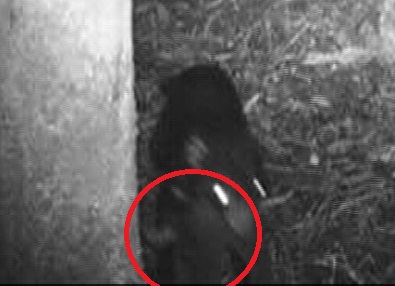
It’s late at night when I get the phone call from Lily Leahy. She is as excited as I am about the 2 seconds of footage and what it shows. She too has watched it over and over again, slowing it down, stopping it at the crucial moment. Taking another look. Who could have known a small dead animal hanging there limply would generate so much excitement between two conservationists. But it is the implications of the dead animal being carried in the mouth of this devil that has got us talking tonight. Why? Because never before have we seen such a thing on our cameras. Devils don’t need to carry their food around, you see. They can eat up to 40% of their body weight in 30 minutes – quiet an impressive feat! So there is no need for storing food unless….. Of course…. you have babies in the den that can’t go and collect it themselves! It looks like what we have here in Julia’s Forest is a mother devil taking food to her young in the den.
The excitement turns to worry, as I flick through footage and dates and data in a state close to panic. What was the date of on that footage? December 12th 2011. No, oh no. What camera was this seen on? 1.1? Yes, defiantly 1.1- there is no denying the reality. Six hours later, machines would be moving in as logging begins within 100 meters of this location. I hope she made it back to the den. I hope the babies are safe.
Next I call Colette Harmsen, a vetinarian whose special interest is the care of Tasmanian wildlife who has been working closely with devils for the past 5 years. She confirms the hypothesis Lily and I have discussed. “I definitely wouldn’t expect a devil to carry food anywhere except to take it to its young” she said. “At this time of year the babies are getting too big to be carried in the pouch or on their mother’s back, but they aren’t yet old enough to be fully independent. They would be waiting at home in the den while Mum goes scavenging for food for them. ”
“If devils were denning close to where logging is happening, this would cause major disturbance, including from noise and vibrations from machinery. Devils are particularly sensitive to unfamiliar noises, as their hearing is exceptional, so any loud noises are likely to disturb them” Colette said.
There is a real risk that young devils could die within dens. From her experience working with devils Colette explains that the typical behavior of a wild devil when it is threatened is to freeze, hide and stay very still almost as if immobilised with fear, rather than to run away. “We get a lot of calls from people who have a devil trapped in their shed or garage and they think that it is really sick because it isn’t moving. But usually it is just scared and that is how they tend to react.”
The real problem seems to be a lack of research. From talking to Colette and others who work with devils, there just hasn’t been enough research done to establish the full impact that forestry operations would have on den sites. For the industry to continue to decimate potential devil dens without even knowing fully the impact this will have is inconceivable, when considering the very real threat of extinction that may be facing the species.
“There is no doubt that there would be devil babies buried when machines move into new areas. Because there are currently no laws or proscriptions requiring Forestry to meticulously check areas for devil dens” said Colette.
We talked about what might happen to the devil seen on our camera, and to her babies. Even if she realised something wasn’t right and managed to get the babies out of the den it may be very difficult for them to survive. Relocating them at that age is problematic because they are too big for her to carry. And if they are in a state of fear due to un-known noise disturbances they may react unpredictably. There is also the very real problem of finding a new home. Devils seem to be picky when it comes to finding the right den, because there are specific conditions that need to be meet in order to keep the babies safe. For example an ideal den has small side-chambers for the pups to hide in to keep them out of reach of danger. Devils rely on old wombat burrows, caves, or other ready-made homes and these can be in short supply, and can be especially hard to find in areas where borrowable soil is limited. “Unless the mother already knows of another possible denning site, it would be very difficult for her to relocate the babies quickly” Colette said.
According to David Owen and David Pemperton: “Habitat interference affects animals by altering the refuges where they breed, raise young and rest. For the devil this could be critical. Maternity dens are carefully selected to provide a safe haven from the elements and from scavengers. Young devils get cold easily and need the warmth from their nests and the sun. Favored dens are strongly protected and may have existed for centuries. Destroying them through, for example, land clearance, disrupts population stability” (Owen and Pemberton 2005:76).
Due to the impact of DFTD (devil facial tumor disease) the death of one healthy devil can have a major impact on population stability in an area. Because so many devils are dying at a young age, sometimes not even old enough to breed successfully, the birth of new devil pups is significant. “The loss of any healthy individual devil is a significant loss for the genetics of the population in that area” said Colette. “Devil babies represent the potential new healthy generations. DFTD is having a drastic impact on devil populations and we need to be doing all we can to protect this species. More research is urgently needed as to the impact of logging and other disturbances.”
Despite these concerns, Forestry Tasmania is taking no action to ensure the safe survival of the devil seen here on our camera, or her babies. We have not seen any devils on film since the logging started and we can only hope that she has managed to relocate them to safety. It is hard to tell from the brief glimpse of her on this footage if the mother devil is Davina or a different devil, though it seems like it could be a different one. We will keep putting out the remote sensor cameras and see if we see her again. In the meantime, I guess it’s time to really put the pressure on the government, Forestry Tasmania and Ta Ann to stop the destruction of devil habitat before Tasmania loses another iconic species forever.
Reference:
Owen D and Pemberton D (2005) Tasmanian Devil: A unique and threatened animal. Allen and Unwin Publishing: Melbourne.
Miranda’s Daily Blog: Day 15
Following on from my Day 14 Blog, I made this little film for you, to show the process of checking up and monitoring the fauna cameras. My apologies for the late post, I had some power problems last night, but I’ve got the computer going again this morning. Make sure you check the website again this evening, because I am working on a very exciting blog for today… about something very interesting captured on film from one of our fauna cameras! So stay tuned!
Till Then, hope you enjoy the film.
Miranda
Guest Blog: Miranda’s family offer their support and Christmas wishes
In the first of The ObserverTree’s guest blogs Miranda’s family talk about their support for her campaign to protect Tasmania’s ancient forests. Glenys, Dave, Rhiannon and Simone all wish Miranda a happy Christmas and send their love. They encourage everyone to get behind The ObserverTree.
Miranda’s Daily (Video) Blog – Day 7
Watch Miranda’s Day 7 Blog on video and get a tour of daily life up in the ObserverTree:
New ObserverTree Video
Amazing forest activist Miranda Gibson takes on the loggers and Government in new ObserverTree project. Please spread this video far and wide!


 T h e O b s e r v e r T r e e