Category Archives: Videos
Miranda’s Daily Blog: Day 161
I couldn’t help feeling worried, looking into it’s small eyes seen through a camera’s lense. A cute and curious pademelon, checking out one of our fauna cameras. (Filmed close to the base of my tree). But all I could think of was the sound of gun-fire I’d heard over and over again the other night. All I could think is that I hope they didn’t spot her. I hope she didn’t hop out into the brightness of their lights. I hope she didnt make the fatal mistake of wandering into a clearfell.
You might have been wondering when I wrote about the animal shootings that happen here, why do they do it? Is it for food? Sport? Population control? No. . Is it for economic gain for the forestry industry? Yes. After clearfelling and burning the native forest (forcing animals out of their homes and killing countless more in the process) the industry comes back in for another round of destruciton.
Every seedling that sprouts up through the ashes of a clearfell is, in the eyes of the forestry industry, money. Each one represents a tree of the future, to be chopped down and sold to make money in about 80 years time. And since, in the eyes of Forestry, each one is their property, I guess they feel the right to defend them at gun-point.
“Forestry Tasmania conducts animal culling operations in State forests to control the effects of mammal browsing on tree seedlings. Brushtail possums, Bennets wallabies and Tasmanian pademelons (rufous wallabies) are trapped and shot under permit for this purpose” (State of the Environment Report 2009)
It seems like a cruel trap for the poor pademelons. The industry has created an occurance that is unusual in the natural forest, a entire field of sprouting seedlings. The pademelons probably can’t believe their luck when they stumble across such a sight while hoping through the forest. And quickly settle in to have a good hearty meal. In the natural world, Pademelons munching on newly growing trees wouldn’t be a problem. There is a balance to the forest, so that if some young plants get eaten, there are others that will survive and grow to be old trees. But the world of Forestry Tasmania is not like the natural world.
In one year, by FT’s estimates over 15,000 “coupe visits” (as they called it) occured. Based on Forestry Tasmaina’s documentation almost 18,000 native animals are culled during a three month period. The slaughter of these animals is what Forestry Tasmania call “browsing managment” and its purpose is to ensure a lucrative crop of regrowth from which they can make money in the years to come. In the natural cycle of the forest animals do not need to die on this large scale in order for the forest to regenerate.
As I try to sleep on the killing nights, I think about the irony of the words that the industry use to frame the debate around forests. Everyone is talking about “peace” in the forest. But what they are referring to is us, those who care about the forest. That somehow when we try to take a stand to protect these ecosystems we are creating conflict. They can twist and obscure the meaning of the word “peace” all they like, but as the saying goes, actions speak louder than words. As I sit quietly in my tree and listen to the sounds of gunfire; it’s like a war zone out there. Search lights flashing across the sky, gun shots being fired. There is no peace in the forest, and it isn’t becuase I am sitting in this tree, and it isn’t becuase people reading this blog are signing the cyber action. Its because the industry has refused a cease-fire. They have continued to kill and destroy everyday while the negotations have continued.
I hope that one day soon there will be peace in these forests.

Guest Blog: Sea Shepherd
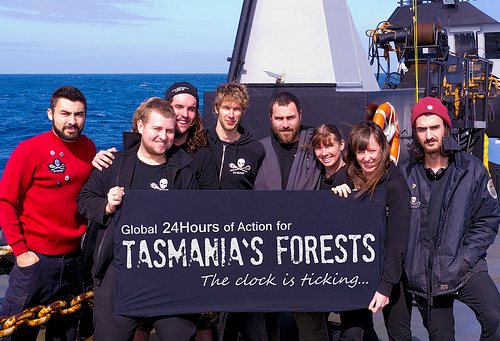
The 2012 Bob Barker crew from The Sea Sheperd recently visited The Observer Tree.
Guest Blog Bio: Sea Seapherd
Established in 1977, Sea Shepherd Conservation Society (SSCS) is an international non-profit, marine wildlife conservation organization. Our mission is to end the destruction of habitat and slaughter of wildlife in the world’s oceans in order to conserve and protect ecosystems and species.
Sea Shepherd uses innovative direct-action tactics to investigate, document, and take action when necessary to expose and confront illegal activities on the high seas. By safeguarding the biodiversity of our delicately-balanced ocean ecosystems, Sea Shepherd works to ensure their survival for future generations.
Miranda’s Daily Blog: Day 144
Wow! How bright is the moon tonight? It is spectacular. Tonight it is apparently a “super moon.” A natural phenomenon in which the moon is extra-large, the biggest it will be for the year. How special to get to view it from the upper canopy of the forest. I wasn’t sure how much I would get to see it. Early on in the evening the cloud cover was thick. And although the night was exceptionally bright, I could only see the moon itself in very quick glimpses, as the clouds faded for a moment. Now, however, it is shining brightly. A wispy thin layer of cloud rushes past, illuminated in the brilliant light of the moon. It’s a nice night to be in a tree!
Well, I have something very exciting to share with you tonight! I have decided to start a new video blog series for you. It’s called “Conversations with Miranda.” It is a talk show, Observer Tree style, featuring a different special guest each episode. Now, I don’t know how frequently the episodes will be, as it’s not all that often I get visitors to my place! But tonight I am launching the first episode, with special guest Lily Leahy. Lily is one of my best friends in the whole world. And as well as being a great friend Lily is also a great plant nerd, always identify plants where-ever she goes and sharing interesting little facts about them. Lily and I are co-authors of Flora and Fauna of the Upper Florentine Valley. And in this little film you get to learn all about the plants that grow in the forest around my tree. Plus some handy hints on getting started with becoming a plant nerd too! We even take you on a tour of my tree tops, to check out some of the life growing in the upper canopy of the Observer Tree. I hope you enjoy watching it as much as Lily and I enjoyed making it.
Please take a minute to help defend Tasmania’s ancient forests.
Click HERE to sign the online cyber action.
Miranda’s Daily Blog: Day 130
Today marks the beginning of an international week of action called “Occupy the Trees.”
The week long action has been initiated by conservationists from the Cascadia region in the US, in order to “draw attention to the entities who exploit and destroy the planet for the sake of profit.” The call to action includes 3 main points which are:
- Immediate attention and reversal to Global Climate Change which threatens all life on Earth.
- Disruption of the Earth-destroying profit machines led by the richest1% of the world and their government lackies.
- Ending all Commercial Extraction from Public Lands in all nations of the Earth.
You can find out more at occupythetrees.org
Tasmanian forest groups Still Wild Still Threatened, Huon Valley Environment Centre and Code Green are getting on board with a week of events to draw attention to the urgent need to end the destruction of the earth. Some events include:
Tuesday April 24 there will be a Kids Afternoon at the Huon Valley Environment Centre 4-6pm. Sharing food, tree craft fun, tree planting and storytelling.
Thursday 25 April Action for the rights of the animals – Defend the Devil. Stay tuned for more info.
I am super excited about being a part of Occupy the Trees. It definitely fits in well with what I am doing! And so as part of the international week of action The Observer Tree is having a virtual Open Day all week… anyone who is keen to chat to me about what I am doing up here can organise a time to Skype with me. You could even get together with a group of friends or colleagues, or put on a little community forum and I would love to talk to you live from the tree tops. Just email me: observertree2011@gmail.com
And to start the week off, here is a new short film about what I’m doing in the tree tops! This film was made by Joel Philp and is a great introduction to The Observer Tree. Check it out and spread it around…
Miranda’s Daily Blog: Day 124
Today I was visited by a class of university students who are studying environmental journalism. It was great to be able to chat with them (over the walkie-talkie) and answer their many questions about what I’m up to. Hopefully they will write some interesting articles about The Observer Tree. Here is a short video of some of their comments about visiting me today:
In other news, I am super excited about my up-coming interview on Primary Perspectives. It’s a very inspiring project – a radio program “created by kids for kids.” It’s so great to see young people getting active and having a voice and I’m really looking forward to chatting with them tomorrow (Tuesday April 17). If you’re in Melbourne you can tune in on 94.1FM or otherwise check out the website for live streaming or pod-casts. My Observer Tree video even made it onto their website as the “hot vod” of the month. Check it out HERE.
Miranda
Miranda’s Daily Blog: Day 122
Hope you enjoy this film. I actually took this footage a little while ago, so technically it is not a description of day 122. But I thought you might like another video blog to see what everyday life is like up in the tree sit.
Today was the most perfect sunny day. I climbed around from branch to branch to make the most of it … chasing the sunshine around the tree! And now with the sun down, the night sky is offering a very spectacular display of stars. I might take my swag out from underneath the tarp and fall asleep looking at the stars!
Talk again tomorrow,
Miranda.
Miranda’s Daily Blog: Day 118
It snowed again!
So, I thought I would put together a little video of footage I recorded on day 100, the first snow day. Thanks to the lovely people at the Hobart Computer Repairs shop who donated their time to retrieve the data from my computer and hard-drive that were damaged on that night… Now I have been able to salvage that footage to show you how beautiful this forest is in the snow. I also have recovered the blog that I was writing for you on that day. Here it is:
“I had this dream last night. I awoke in the middle of the night marvelling at the insights of my dream. I was sure I’d never forget it. But when I woke in the morning I had no recollection of any of it. What I did remember was the thoughts that it inspired, the lessons I must have learnt from the dream, that I had lay awake turning over in my mind. I had been thinking about the importance of appreciating every moment for what it is. Not wanting it to be more or less. Not being distracted by thoughts of the future or the past. Not wishing to be somewhere else, doing something different. It was all about staying present and mindful. In a way it lead me to think about not just appreciating the moment, but really noticing it. I guess that is a form of meditation, in some ways. It was after these middle of the night epiphanies, that I awoke to one of the most splendid mornings in the world! And I was able to put those thoughts into practise as I spent time watching the snow falling. It is so mesmerizing, snow falling. It is like magic. The way it drifts through silently. The way the forest looks in the snow is like something out of a fairy tale.
Today we had all kinds of snow: snow mixed with rain that is more like sludge, light fluffy snow meandering weightlessly through the sky, heavy pelting snow driven at full force by the wind, hail bouncing off the platform. Sometimes the wind swirled the snow, ripping it through the air, it felt like being in the middle of a blizzard. And other times it was so silent and soft. The intermittent rain meant that the snow didn’t settle on the forest. But in the brief moments when the clouds relinquished their grip of the mountain tops around me, I could see the thick white blanket covering the ridges.
That’s how I spent my 100th day. Watching the snow fall. Staying present in every moment, appreciating every snow-flake that I could lay my eyes on. My toes and fingers a little numb. But happy and content all the same.”
Hope you all had a great Easter weekend. I had such a nice time, with lots of visits from people who were out attending the skillshare at Camp Florentine. And thank you to all the people who couldn’t make it out, but sent along notes and letters of support! What a lovely weekend of snow, visitors and of course chocolate!
Miranda
Miranda’s Daily Blog: Day 114
This is footage taken on Wednesday. It shows some of the destruction that is continuing to occur within the 572,000 hectares of forest that has been verified as having significant high conservation value, national heritage value and world heritage value.
The footage shows first an area of forest called Butlers Gorge. In the footage you can see not only logging operations occurring, but also new roads being pushed into areas of pristine and previously untouched wilderness. In fact, this area of forest has been recommended for inclusion in the Tasmanian Wilderness World Heritage Area precisely because it is such a significant area of untouched wilderness. The West report described this area as one of the most, if not the most, significant tract of Tasmania’s tall eucalypt forest. Until about a decade ago it had no disturbance from logging or roading. And the majority of the area remains intact. It is outrageous that now, when it has been recommended as World Heritage, when negotiations are going about its future protection, that new roads would continue to be pushed in to the pristine tracts of forest there. They are compromising the very values that they are talking about protecting! This is the reason that we need an immediate moratorium on logging in the 572,000 hectares. To continue to log the very areas they are discussing as the potential future national parks and world heritage areas just doesn’t make sense. By the time they decide whether or not to protect them, how much of the forest will they have degraded or destroyed?
After the footage of Butlers Gorge, the video shows a devastating burn off in the Plenty. This is an area also within the 572,000 hectares of verified high conservation value forest. This burn off was the topic of an article in the Mercury today (which you can read by clicking HERE).
Finally the footage shows a blackened and still smoldering clearfell in the Weld Valley which was burnt about a week and a half ago. A group of conservationists gathered in the clearfell to hold a banner reading “Stop selling forest destruction.”
I think the footage speaks for itself, in showing the reason why a moratorium on these forests is so necessary. This moratorium is long overdue. Originally due to be in place by March 15th 2011; over a year ago now! And then when the IGA was signed in August last year, it said a conservation agreement would be put over 430,000 hectares, this was never fully implemented. The IGA also stated that once the verification process was complete (as it is now) the conservation agreement would need to be renewed to take into account the recommendations and information in the West report. Therefore, a new conservation agreement should be put in place over the full area of forest that has been verified. This includes these areas depicted in the footage above.
The fact that they are putting new roads into some of these areas raises serious questions about whether there is any intention to stop logging there. Why would Forestry Tasmania be wasting taxpayers money on constructing roads into areas that are being negotiated over and that have been recommended to be included in the World Heritage Area.
You can listen to the PM radio show coverage of the issue here: PM: “Stand off in forest peace deal”
Check out the news coverage from Monday night, about our “olive branch” offer:
Click HERE to view footage of Monday’s press conference with Peg Putt (Markets for Change), Jenny Weber (Huon Valley Environment Centre), Ula Majewski (The Last Stand) and me (Still Wild Still Threatened: skyping in from the Observer Tree).
Hope you are all having a good easter break! For those of you in Tasmania, why not spend the weekend in the wonderful Upper Florentine Valley? There is a great skillshare running at Camp Floz which will include lots of hands on workshops, discussions and walks (with a guided visit out to The Observer Tree too). stillwildstillthreatened@gmail.com for more details.
Take care and talk soon,
Miranda
Miranda’s Daily Blog: Day 111
Did you see Q and A on ABC last night? I sent in a video question for Terry Edwards (of Forest Industries Association of Tasmania). It was great to see they included my question! (Although they did cut my video off part way through). Here is the segment of the show featuring my question and the response from the panel.
I have to wonder if Terry Edwards has been paying attention in all those meetings over the past two years. His reaction to my question gives the impression that he has never heard anyone mention the figure of 572,000 hectares until now. He claims that environmentalists have upped the stakes from 430,000 hectares to 572,000. The figure has always been 572,000. It was the industry that pushed it down to 430,000. The Intergovernmental Agreement listed only 430,000 hectares to be put into a conservation agreement, though it still lists the full 572,000 as open for potential new reserves and it is that full area that was assessed by the expert team, lead by Professor West. The expert team looked at that full area because 572,000 hectares was what was on the table as proposed reserves from environment groups. And when they assessed the values, they found that it all contained substantial conservation values, including world heritage value. That is why it is crucial that logging is stopped immediately in that area. How can they continue to destroy the very forests they are sitting in a room talking about protecting. As they speak, the very values that have been verified as worthy of protection are being degraded on a daily basis, while logging occurs.
I found it very intriguing that Terry brings up the Trades Practices Act, saying that people shouldn’t misrepresent their products. This is a very odd comment considering that environmental groups have been the ones who have had to go out and tell the truth about the lies and misrepresentations being made by Ta Ann (a company represented by his organisation). Ta Ann tell their customers the wood comes from plantation. The reality is that it has been officially verified that they are driving the destruction of high conservation value forests.
As Andrew Wilkie pointed out, there are a range of reasons why the forest industry is in crisis. Including the fact, which has been verified by Professor West, that the industry has been over-cutting the forests. And in addition that Forestry Tasmania have made contracts that are not even possible to be fulfilled. Contracts are going to have to be renegotiated anyway, if the wood is simply not there. So why not make the changes needed to conserve these forests that have now been verified as globally significant?
It will be interesting to see how the rest of the industry and government respond to our offer of a suspension of the markets campaign, if a moratorium on logging is put in place. I guess we will have to wait and see if they respond over the next few days. Forestry Tasmania have come out very quickly, in what seems to be a knee-jerk reaction. Interestingly they are claiming that they cannot suspend logging because that area accounts for 50% of their contracts. And that it can take up to 9 months for them to re-work their Forest Practices Plans to move logging to other areas. These two facts raise serious questions about FT’s committment to the negotiations. If they claim they can’t get out of the high conservation value forests now, then will they ever be willing to? What about in when the negotiations are finalised – Will they still claim they have to keep logging and logging and logging? Will they still want to continue to log at double the sustainable yield, as was found to be the case with their current practices? If they cannot even meet a moratorium (over due by a year now, so they have certainly had enough time to plan!) then how will they respond to the rest of the negotiated outcome? The question that needs to be asked then, is how serious is the industry about finding a solution?


 T h e O b s e r v e r T r e e